1. What is ad fatigue?
Ad fatigue is a phenomenon that occurs when a target audience is repeatedly exposed to the same advertisement too frequently or within a short period. As a result, users gradually stop paying attention, begin to ignore the ad, or even develop negative reactions toward it.
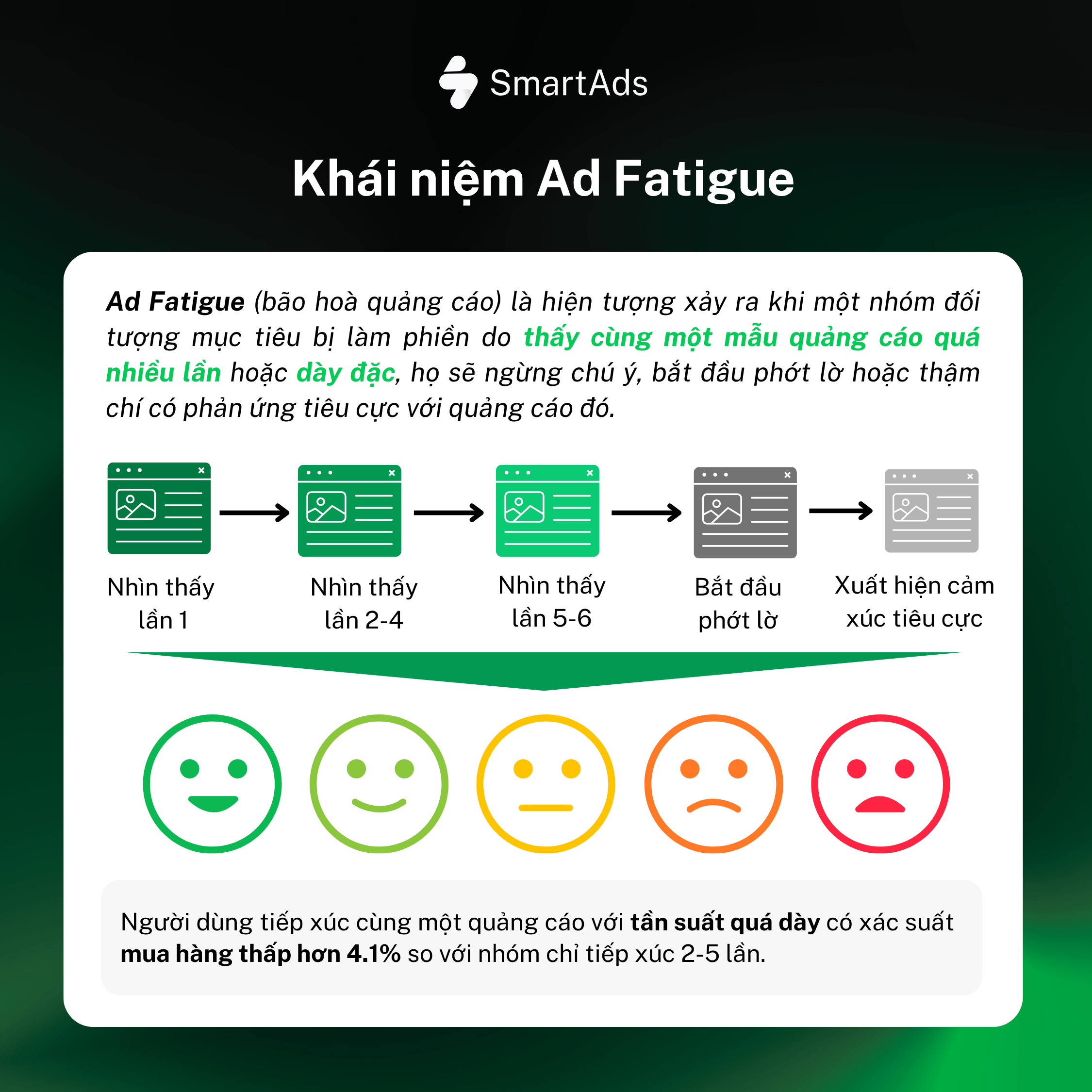
This phenomenon does not necessarily indicate that the product is unattractive or the advertising budget is insufficient. Instead, it reflects how the human brain naturally filters out stimuli that have been processed repeatedly as a self-protection mechanism. This explains why an ad that once delivered outstanding performance gradually loses its effectiveness over time, even when the creative and messaging remain unchanged.
2. Common signs of ad fatigue
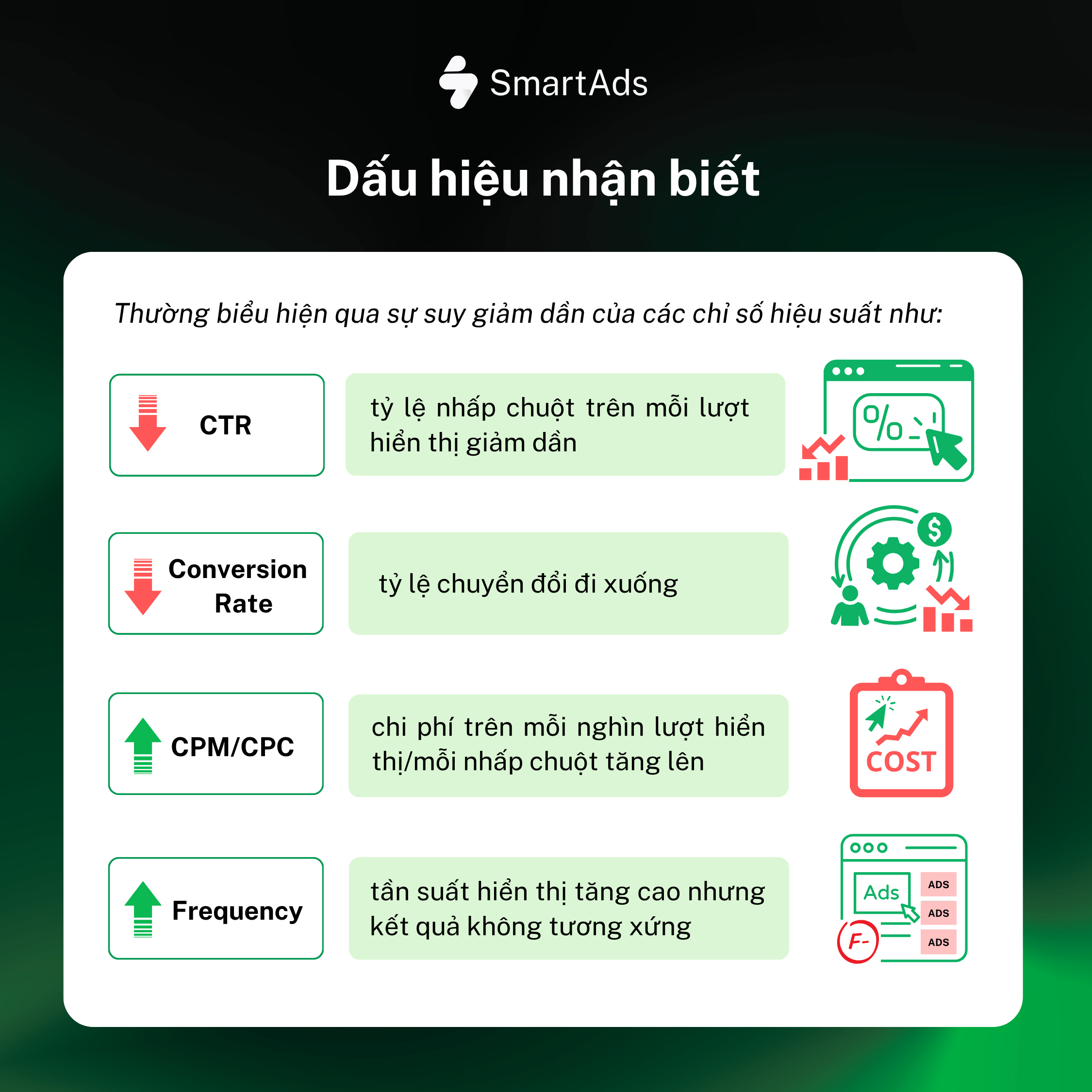
Ad fatigue is typically reflected through a gradual decline in key advertising performance metrics, including:
-
CTR (Click-Through Rate): declining click-through rate despite stable impressions
-
Frequency: increasing ad frequency without a proportional improvement in results
-
CPM/CPC: rising cost per thousand impressions (CPM) or cost per click (CPC)
-
Conversion rate: declining conversion performance
>>> Read more: How to control ad frequency with frequency capping
3. Why ad fatigue happens and its main causes
Understanding the root causes of ad fatigue is the first step toward preventing it. Below are the most common factors that contribute to this issue.
3.1. Excessive ad frequency (High frequency)
This is the most direct and common cause of ad fatigue. When users are exposed to the same advertisement too many times within a single day, their attention naturally declines. In most cases, this happens when the target audience is too small relative to the campaign budget or when no frequency cap is implemented. According to research cited by Simulmedia, users who see the same advertisement 6–10 times are 4.1% less likely to make a purchase than those exposed only 2–5 times. This highlights the trade-off between higher ad frequency and actual campaign effectiveness. (Source: RevenueCat, 2025 - Detecting ad fatigue in 2025).
On the other hand, the concept of Effective Frequency suggests that users generally need to encounter a brand's advertisement approximately three to seven times or even more before they begin to remember and consider choosing that brand. Although this may appear to contradict the research above, both perspectives complement each other when interpreted correctly.
The issue is not the total number of impressions itself, but how those impressions are distributed over time. Concentrating too many exposures within a single day significantly increases the likelihood of ad fatigue. Instead, marketers should spread impressions across multiple days and avoid allocating the entire advertising budget to just one channel. Distributing campaigns across multiple advertising platforms allows brands to achieve effective frequency while minimizing the feeling of being "followed" by the same advertisement.
3.2. Lack of creative diversity (Creative fatigue)
Modern consumers encounter hundreds of advertisements every day, making the human brain highly sensitive to repetition. As a result, even when ad frequency is properly controlled, relying on only one or two creatives throughout an entire campaign can quickly lead to creative fatigue. This is especially common when brands run the same static image ad for an extended period, repeatedly use the same video with an identical opening hook, or fail to refresh their call-to-action (CTA) messages throughout different campaign stages.
3.3. Incorrect targeting or an audience that is too narrow
This is one of the most common mistakes made by SMEs when they first invest in paid advertising. To avoid wasting budget, many businesses narrow their target audience too aggressively. However, when the audience pool becomes too small, the advertising platform has no choice but to repeatedly serve the same ads to the same group of users. This creates a cycle of excessive ad exposure, gradually leading to ad fatigue. Over time, these users become almost "immune" to the advertisements and stop responding, even as ad frequency continues to increase.
3.4. Using retargeting without a clear strategy
Retargeting is a highly effective marketing tactic, but without proper management, it can quickly become one of the biggest contributors to ad fatigue. Its impact largely depends on customer behavior and the characteristics of each industry.
-
For fast-moving consumer goods (FMCG) such as food, beverages, cosmetics, and other frequently purchased products, customers often make repeat purchases within a short period. In these cases, retargeting with upsell messages, complementary products, or newly launched items is not only appropriate but can also help reinforce purchasing habits and increase customer lifetime value.
-
By contrast, for products and services with longer purchase cycles—such as real estate, insurance, B2B software, CRM solutions, corporate event services, or wedding planning—continuously retargeting a small audience with the same sales message shortly after conversion can dramatically increase ad frequency and trigger negative reactions. Instead of simply ignoring the ads, users may begin to associate the brand itself with annoyance, ultimately damaging overall brand perception.
To maximize the effectiveness of a retargeting strategy, businesses should segment audiences based on customer behavior and align each segment with the nature of their industry. At the same time, advertising messages should evolve throughout the customer journey, focusing on understanding why users disengaged and addressing their specific pain points rather than repeatedly showing the same purchase-oriented call to action.
4. How ad fatigue impacts advertising campaigns
Many businesses underestimate the long-term consequences of ad fatigue. In reality, this issue not only reduces short-term campaign ROI but can also create lasting negative effects on advertising performance and brand growth.
-
Wasted advertising budget: Continuing to invest in a campaign affected by ad fatigue means spending budget on impressions that no longer generate meaningful value. Every impression served to users who have already become desensitized to the ad contributes little to no return, resulting in unnecessary advertising costs.
-
Declining brand sentiment: This is one of the most overlooked yet most serious long-term consequences. When users repeatedly encounter the same advertisement, the annoyance they feel often extends beyond the creative itself and becomes associated with the brand. This is particularly harmful for businesses focused on building brand awareness, as negative brand perceptions are difficult to reverse once established.
-
Lower effectiveness of future campaigns: Advertising accounts with a history of poor-quality engagement, low relevance scores, or frequent negative user feedback may face higher advertising costs and reduced reach in future campaigns. This creates a snowball effect that many marketers fail to recognize until campaign performance has significantly deteriorated.
5. Strategies to prevent and overcome ad fatigue
5.1. Rotate creatives regularly (Creative rotation)
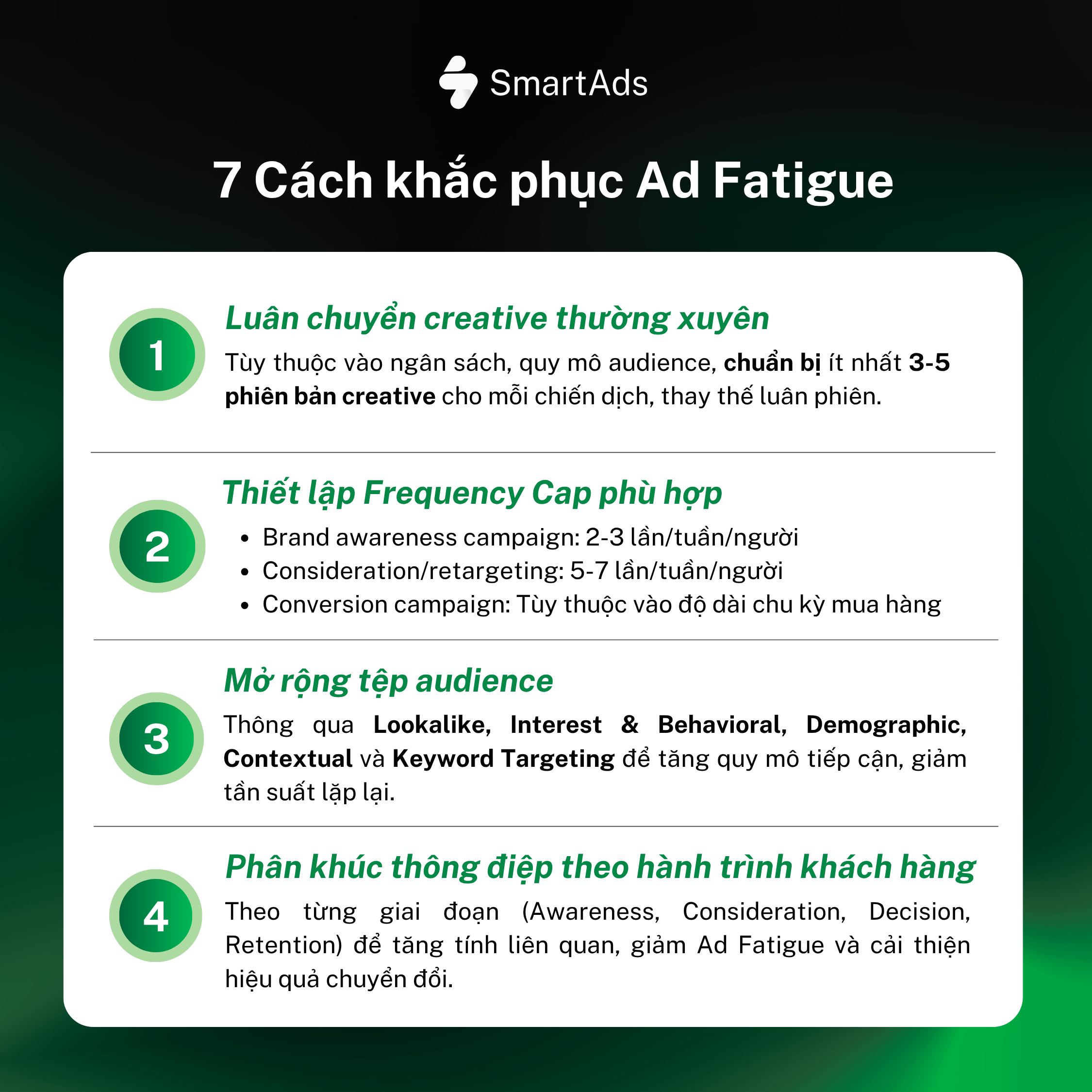
The most fundamental principle for preventing ad fatigue is to avoid running the same creative for too long. Depending on your campaign budget and audience size, prepare at least three to five creative variations for every campaign and rotate them according to a planned schedule. Regular creative rotation helps maintain audience interest while providing advertising algorithms with fresh assets to optimize delivery.
Elements you can change to create new ad creatives:
-
Images or video thumbnails
-
Headlines and descriptions
-
Primary color palette
-
Messaging angle (benefits, features, social proof, urgency, etc.)
-
Ad format (static image, carousel, short-form video, infographic)
Example: A fashion brand running an acquisition campaign could prepare five different creatives from five unique perspectives: (1) Featured products, (2) Real customers wearing the products, (3) Behind-the-scenes production footage, (4) KOL or influencer reviews, and (5) Limited-time promotional offers. Instead of displaying one creative repeatedly, the campaign can run two or three creatives simultaneously. This approach gives the advertising algorithm sufficient data for optimization while reducing repetitive exposure for users and minimizing the risk of ad fatigue.
5.2. Set an appropriate frequency cap
A frequency cap limits the maximum number of times an individual user sees the same advertisement within a specific period. It is one of the most proactive and effective ways to prevent ad fatigue. Recommended frequency cap settings include:
-
Brand awareness campaigns: 2–3 impressions per user per week
-
Consideration or retargeting campaigns: 5–7 impressions per user per week, combined with regular creative refreshes
-
Conversion campaigns: Adjust according to the length of the customer buying cycle
Note: These figures are intended as general recommendations rather than fixed rules. Every advertising platform uses different delivery algorithms, so there is no universal frequency cap suitable for every campaign. As a best practice, maintaining a frequency of approximately 2–7 impressions within a seven-day period helps balance brand exposure while minimizing the risk of ad fatigue.
For retargeting audiences, applying a strict frequency cap is often not recommended because these audience pools are relatively small and campaign budgets can already be difficult to spend efficiently. Instead, advertisers should minimize ad fatigue by diversifying creative assets and excluding converted users from retargeting audiences. In addition, implementing a cross-platform retargeting strategy can improve campaign efficiency by distributing exposure across multiple advertising channels.
5.3. Expand your audience (Audience expansion)
When a narrow audience is the primary cause of high ad frequency, the most effective solution is to expand your target audience. Below are several proven approaches to increase audience reach while maintaining relevance:
-
Lookalike Audience: Build lookalike audiences based on existing customers or users who have already converted. Advertising platforms analyze behavioral patterns, demographics, interests, and engagement signals from the source audience to identify new users with similar characteristics, helping advertisers scale campaigns without sacrificing targeting accuracy.
-
Interest & behavioral expansion: Broaden targeting by incorporating related interests and behavioral signals such as browsing history, content engagement, online purchasing behavior, and demonstrated interest in relevant products or services.
-
Demographic broadening: Expand age ranges, geographic locations, or other demographic criteria where appropriate for your products or services.
-
Contextual targeting: Deliver ads based on the context of the content users are currently consuming. Using AI and Natural Language Processing (NLP), contextual targeting analyzes headlines, article content, topics, and semantic meaning to determine the most relevant environments for ad placement.
-
Keyword targeting: There are two primary approaches:
+ Search keyword targeting: Ads are triggered when users search for specific keywords.
+ Content keyword targeting: Ads are served alongside content that contains or is closely related to the advertiser's selected keyword set.
Together, these audience expansion strategies increase campaign reach by extending targeting across behavioral signals, interests, demographics, contextual relevance, and keyword intent. This reduces repeated exposure to the same users while improving campaign scalability and advertising performance.
5.4. Tailor messaging to each stage of the customer journey
One of the less obvious causes of ad fatigue is delivering the same message to every user regardless of where they are in the customer journey. Instead, marketers should develop layered messaging strategies that address the needs of users at different decision stages.
-
Awareness stage: Introduce the brand, educate potential customers, and spark curiosity without applying immediate purchase pressure.
-
Consideration stage: Highlight key differentiators, compare solutions, and reinforce credibility through testimonials, customer reviews, or case studies.
-
Decision stage: Use limited-time offers, guarantees, free trials, or money-back policies alongside stronger calls to action to encourage conversions.
-
Retention stage: Deliver post-purchase content, loyalty offers, cross-selling opportunities, and upsell recommendations to strengthen long-term customer relationships.
5.5. Monitor performance and set alert thresholds
Rather than waiting until campaign performance has noticeably declined, marketers should establish automated alert thresholds that detect early warning signs of ad fatigue.
-
If CTR drops by more than 20% compared to the previous week: Consider refreshing your creatives or testing new messaging.
-
If ad frequency exceeds your predefined threshold: Pause the campaign temporarily or reduce exposure for that audience segment.
-
If CPM increases by more than 30% without a corresponding improvement in conversions: Review audience overlap, campaign targeting, and creative freshness to identify optimization opportunities.
A proactive monitoring system enables marketers to respond before campaign performance deteriorates, helping save both advertising budget and optimization time while maintaining sustainable campaign performance.
5.6. Diversify advertising channels (Multi-channel approach)
Allocating too much budget to a single advertising channel not only increases the risk of ad fatigue but also creates unnecessary dependency on one platform. A well-balanced multi-channel strategy allows brands to reach users through different touchpoints while maintaining a better customer experience. An effective media mix may include:
-
Social ads to build brand awareness and encourage engagement.
-
Search ads to capture high-intent users actively searching for products or services.
-
Native ads on premium publisher websites to reach quality audiences within relevant editorial content.
-
Display ads to maintain brand visibility through visually engaging banner placements.
Each advertising channel presents a different level of ad fatigue depending on audience behavior, placement, and campaign objectives. By combining multiple channels strategically, marketers can distribute impressions more naturally, reduce repetitive exposure, and build more sustainable advertising performance over time.
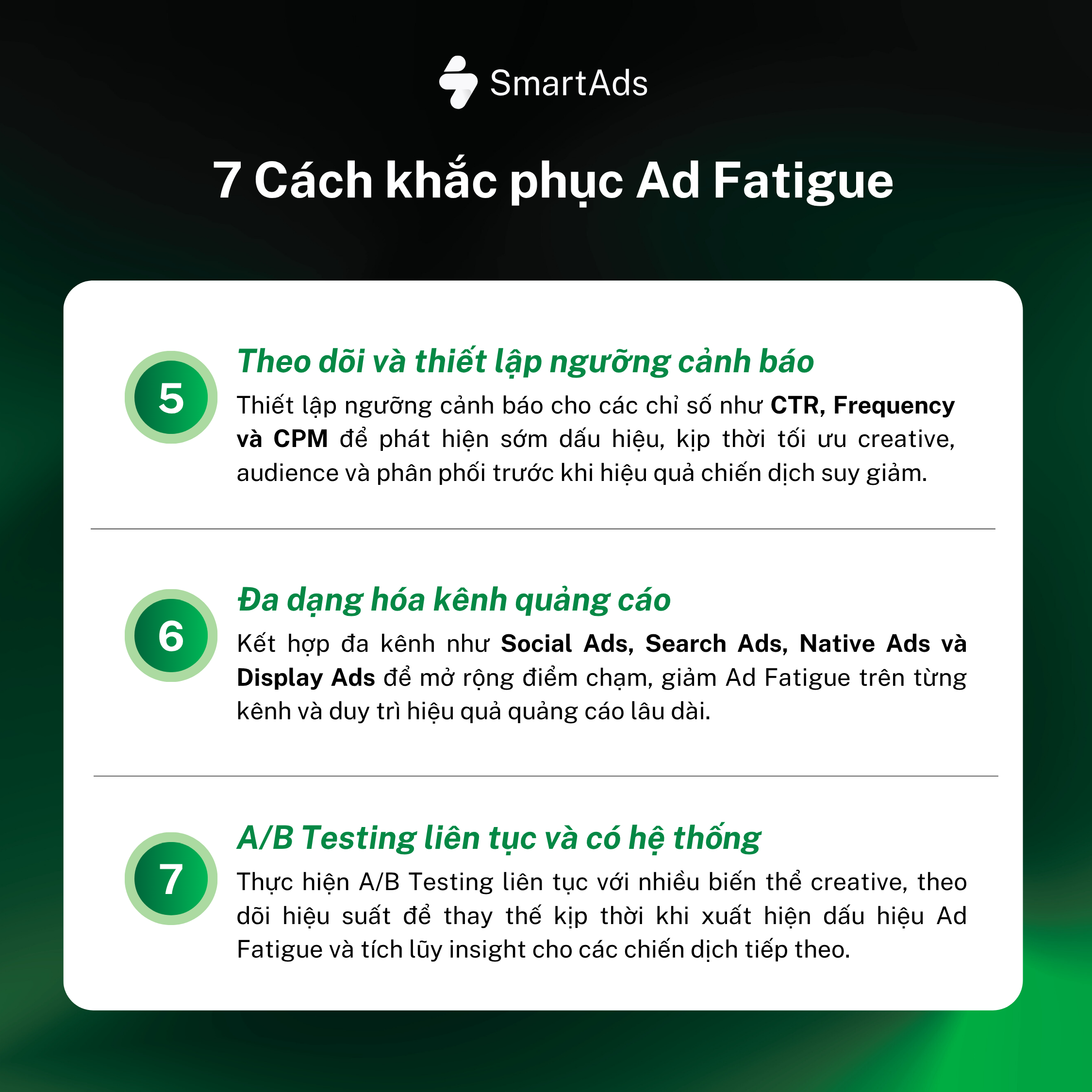
5.7. Continuously conduct A/B testing
Continuous A/B testing is one of the most effective ways to combat ad fatigue. By regularly testing new variations of headlines, visuals, hooks, calls to action, and content structure, marketers can identify high-performing creatives before audience engagement begins to decline. A recommended A/B testing process includes:
-
Run at least two or three creative variations simultaneously for every campaign.
-
Continuously monitor performance and establish clear evaluation criteria to identify the winning creative.
-
When the winning creative begins showing signs of ad fatigue, replace it with a new variation before performance declines significantly.
-
Document test results to build a creative insights library that can improve future campaign planning and optimization.
>>> Read more: A complete guide to A/B testing for advertising campaigns
Conclusion
Ad fatigue is not simply a budgeting issue—it is a strategic challenge that requires marketers to balance ad frequency, continuously refresh creatives, and deliver the right message at the right stage of the customer journey. Businesses that proactively manage these factors can sustain advertising performance, improve campaign efficiency, and maximize long-term return on investment.
With SmartAds' ecosystem of premium publishers and AI-powered Contextual Intelligence targeting technology, brands can reach the right audience, at the right time, and within the right context. This enables advertisers to maximize campaign effectiveness while delivering a more relevant and less intrusive advertising experience for users.