Tet 2026: The Rise of “Pragmatic Celebration” – A More Practical and Calculated Vietnamese New Year
InsightAsia identifies the dominant trend of Tet 2026 as “Pragmatic Celebration” – a way of celebrating the Vietnamese New Year that preserves core traditional values while being more intentional, restrained, and convenience-oriented.
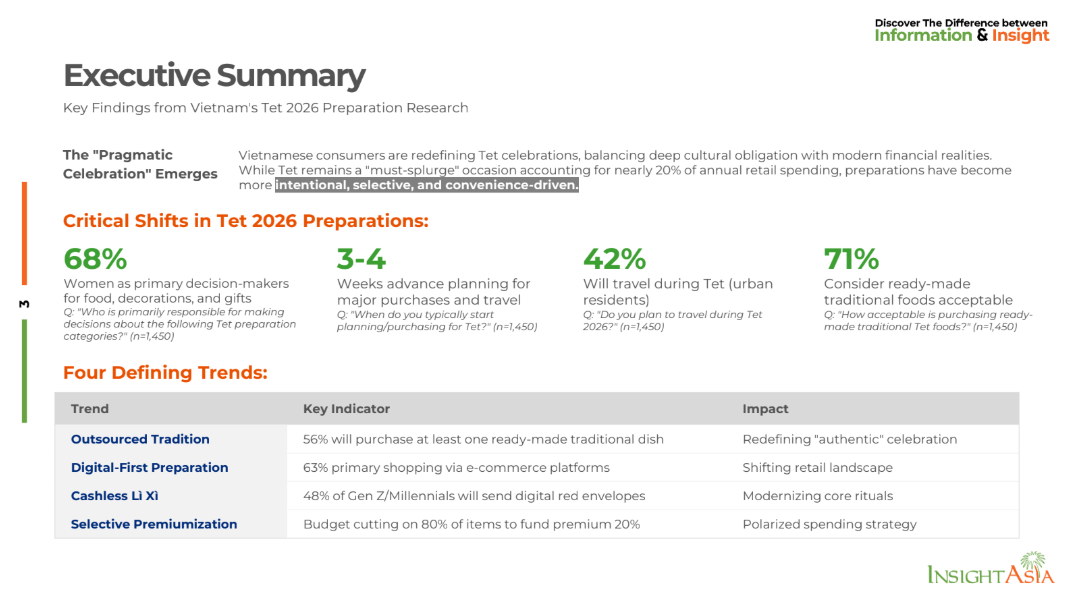
Several notable shifts stand out:
-
Earlier preparation: On average, consumers start preparing 3–4 weeks before Tet, especially for major expenses such as shopping, travel, and gift-giving.
-
Selective spending: Many categories are reduced so budgets can be allocated to items perceived as truly “worth the money.”
-
Convenience-first mindset: Consumers are increasingly open to ready-made products and services, as long as quality and traditional authenticity are preserved.
Notably, 71% of consumers accept ready-to-eat traditional foods, indicating that the concept of a “proper Tet” is being redefined – no longer tied to doing everything from scratch.
>>> Download the full InsightAsia report (PDF) here.
Who Really “Runs” Tet in Vietnamese Households?
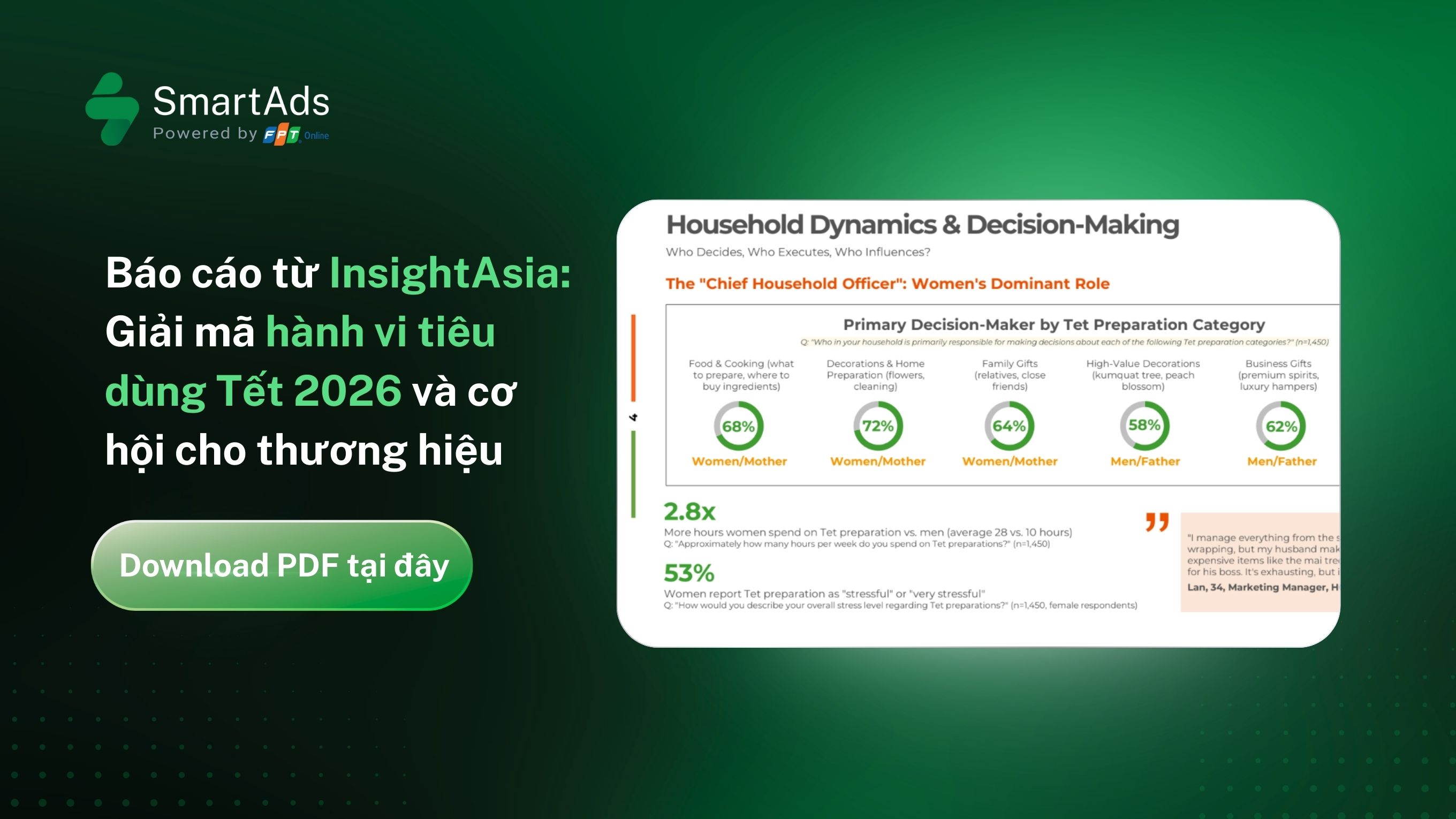
The report highlights a clear reality: women play a central role in most Tet-related decision-making processes.
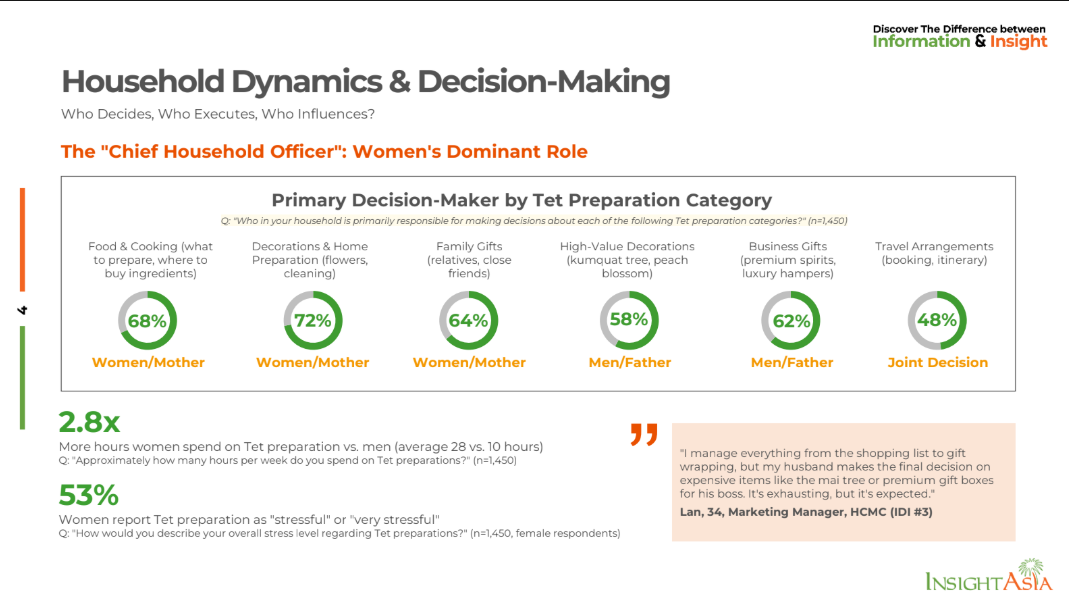
Women – the “Chief Household Officers” of Tet 2026:
-
68% make decisions related to food and meals
-
72% decide on home decoration and cleaning
-
64% decide on gifts for family and relatives
-
Women spend 2.8 times more time preparing for Tet than men
Meanwhile, men tend to be involved in gifts for business partners or supervisors, high-value decorations, and part of major spending decisions.
This creates a notable paradox: women manage most of the workload, yet are not always the final decision-makers for big-ticket purchases. This often leads to pressure and stress. For brands, this insight is critical: reducing the burden on women is a meaningful way to deliver real value during Tet.
>>> 8 marketing ideas for Tet 2026 campaigns.
The Tet 2026 Preparation Journey: From Rush to a Clearly Structured 4-Stage Process
InsightAsia identifies four distinct stages in the Tet preparation journey, each marked by different consumer behaviors:
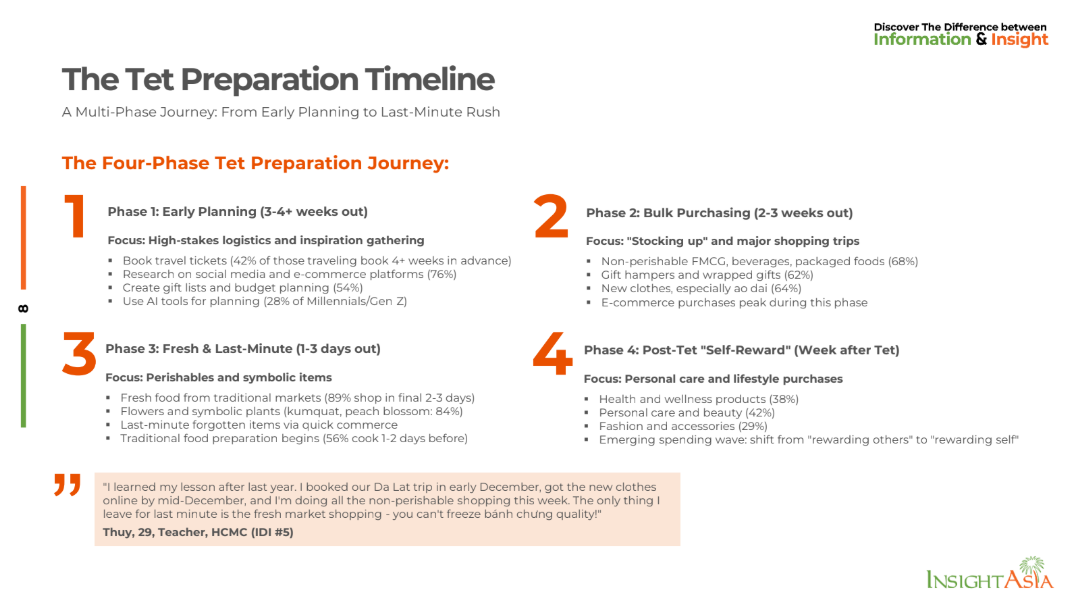
Stage 1: Early Planning (3–4 weeks before Tet)
Main activities include booking travel tickets, planning hometown visits, creating gift lists, budgeting, browsing inspiration on social media and e-commerce platforms. Notably, some Millennials and Gen Z consumers have started using AI tools for planning support.
This stage is driven by inspiration, planning, and brand positioning.
Stage 2: Bulk Shopping Phase (2–3 weeks before Tet)
This phase covers FMCG, dry goods, beverages, pre-packaged gifts, Tet clothing, with e-commerce reaching peak transaction volume.
This is the phase of channel coverage, shelf optimization, and conversion acceleration.
Stage 3: Last-Minute Shopping (1–3 days before Tet)
Includes fresh food, flowers, ornamental plants, and “forgotten” last-minute purchases.
This stage prioritizes speed, convenience, and availability, making it ideal for maximizing final conversions.
Stage 4: Post-Tet “Self-Reward”
Spending shifts toward health care, beauty, fashion, and lifestyle.
Post-Tet consumption is becoming a new growth window rather than ending abruptly after the third day of Tet. This stage is ideal for brand repositioning and nurturing long-term customer loyalty.
Tet 2026 Budget Structure: Reallocation Instead of Cutbacks
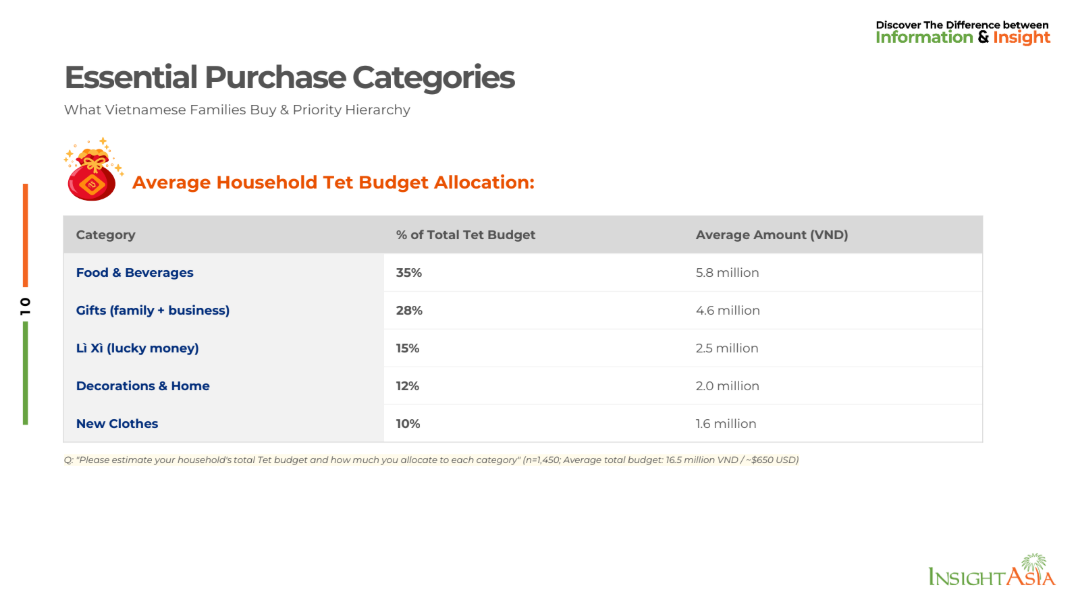
According to the survey, the average Tet budget per Vietnamese household is approximately VND 16.5 million. This indicates that consumers are neither tightening nor overspending excessively, but rather reallocating budgets selectively based on value priorities. Key spending categories include:
-
Food & beverages (35%): The largest budget share, reinforcing that family meals and gatherings remain central to the Vietnamese Tet experience.
-
Gifts for family and business partners (28%): Nearly one-third of the budget goes to gifting, reflecting Tet’s role in maintaining social and professional relationships.
-
Lucky money (15%): A culturally non-negotiable expense, reflecting ritual and tradition.
-
Home decoration & cleaning (12%): Still important, but with a focus on moderation and efficiency rather than extravagance.
-
New clothing (10%): The smallest share, especially among younger and urban consumers.
Overall, 63% of Tet spending is concentrated on food and gifting, reinforcing Tet 2026 as a celebration of relationships and family rather than individual self-expression.
Where Do Vietnamese Consumers Shop for Tet? The Rise of Multi-Channel Behavior
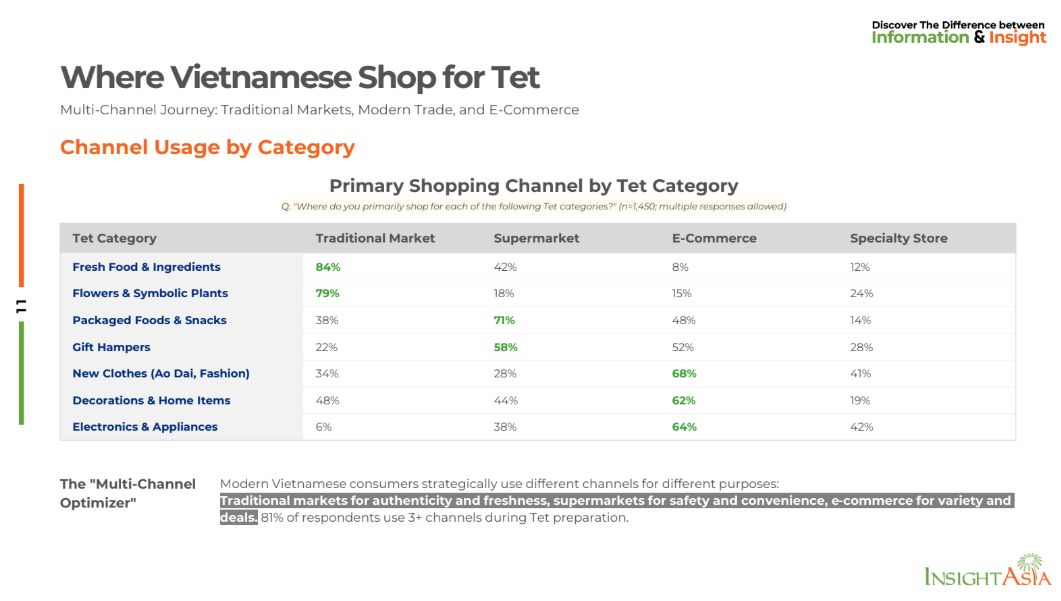
Beyond budget allocation, another major shift is evident: consumers no longer rely on a single shopping channel. Instead, channel choice depends on product category and usage context.
#1. Traditional Markets: The Channel of Authenticity and Emotion
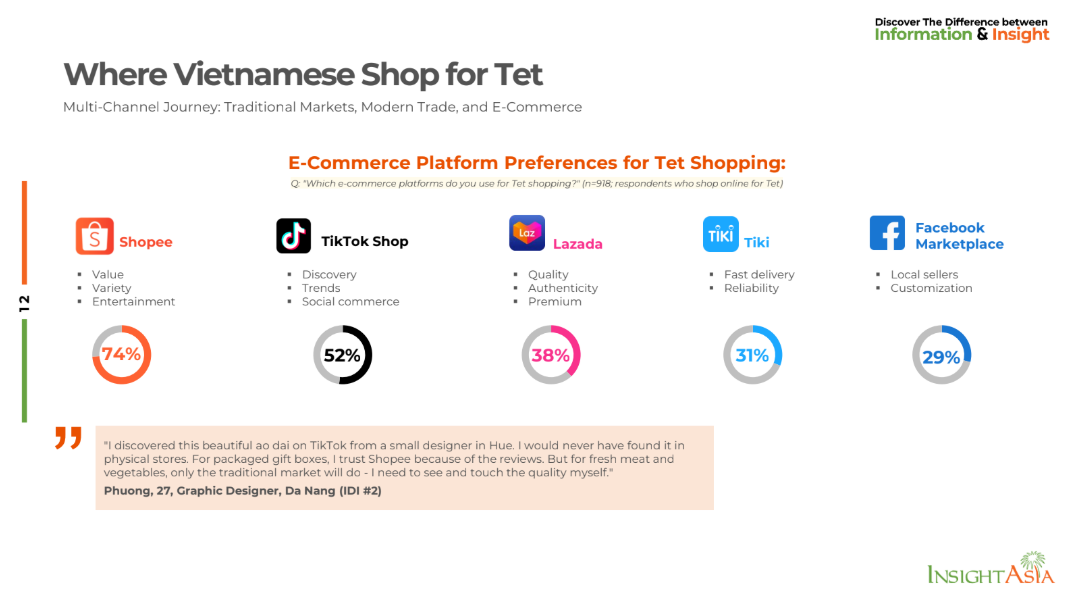
Traditional markets remain the top choice for sensory-driven categories:
-
84% buy fresh food at markets
-
79% buy flowers and ornamental plants at markets
Despite the growth of modern retail and e-commerce, traditional markets continue to symbolize freshness, trust, and the “true Tet atmosphere.”
#2. Supermarkets: The Safe Zone During Tet
Supermarkets dominate categories where reassurance and convenience matter:
-
71% buy dry goods and snacks
-
58% buy Tet gift baskets
Standardization, traceability, and low perceived risk make supermarkets highly competitive in cautious spending environments.
#3. E-commerce: The Channel for Rational Decisions
E-commerce is no longer secondary during Tet 2026:
-
68% buy Tet clothing online
-
62% buy home decor and household items online
-
64% buy electronics and appliances online
E-commerce supports rational decision-making through comparison, variety, and value optimization.
#4. Multi-Channel Shopping as the New Standard
Online channels are influential but do not fully replace offline ones. According to the report, 81% of consumers use three or more channels during Tet preparation, making the journey fragmented and non-linear.
The challenge for brands is no longer “which channel to choose,” but:
-
Are you present on the right channel?
-
At the right moment?
-
With the right role consumers expect from that channel?
Digital payments are accelerating, but consumer behavior remains fragmented by context and region
About Digital payment behavior
According to market data, digital payment methods such as e-wallets, bank cards, and bank transfers have become increasingly popular across many Tet spending categories. However, cash continues to play an important role in highly traditional contexts during the Vietnamese New Year.
-
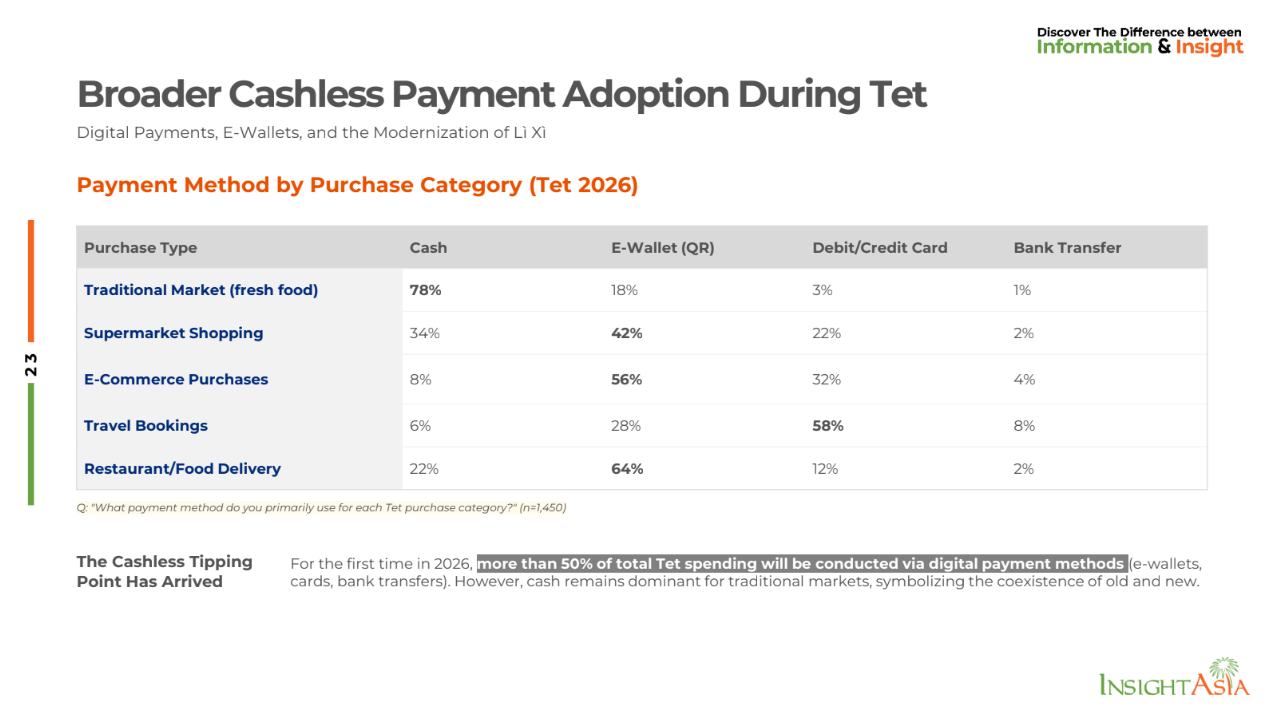
Traditional markets and fresh food: In traditional markets, cash remains the primary payment method, accounting for 78% of total transactions. This reflects the nature of these settings, where transaction values are small and frequent, making cash a fast and contextually appropriate choice in traditional retail environments.
-
Supermarkets and modern retail: In supermarkets, payment behavior has clearly shifted toward digital options. 42% of consumers use e-wallets, exceeding cash payments (34%). Organized shopping environments, combined with cashback programs, loyalty points, and wallet-based promotions, are accelerating the decline of cash usage in modern retail during Tet 2026.
-
E-commerce: Digital payments have become the standard for online shopping during the Vietnamese New Year. E-wallets account for 56% of transactions, while cash on delivery has dropped to just 8%. This indicates that COD is losing relevance during peak shopping periods as consumers prioritize speed and seamless experiences.
-
Travel and high-value services: 58% of consumers use debit or credit cards. In these high-ticket categories, security, installment options, and bank-led incentives play a decisive role, reinforcing the dominance of card payments.
-
Dining and food delivery: E-wallets clearly dominate with 64%, far surpassing cash (22%) and bank cards (12%). QR payments have become an almost default habit, driven by speed and convenience in immediate consumption scenarios.
>>> Marketing strategies for restaurants during Tet 2026.
Overall, consumers choose payment methods based on contextual relevance rather than following a single dominant trend. Cashless payments have moved beyond the testing phase and entered a period of rapid adoption. At the same time, cash has not disappeared; instead, it remains firmly rooted in traditional and socially driven consumption settings during Tet.
Regional cultural differences
Beyond differences in rituals and traditions, recent data continues to show clear divergence in Tet shopping behavior between Hanoi and Ho Chi Minh City, particularly in brand selection, shopping channels, and acceptance of e-commerce.
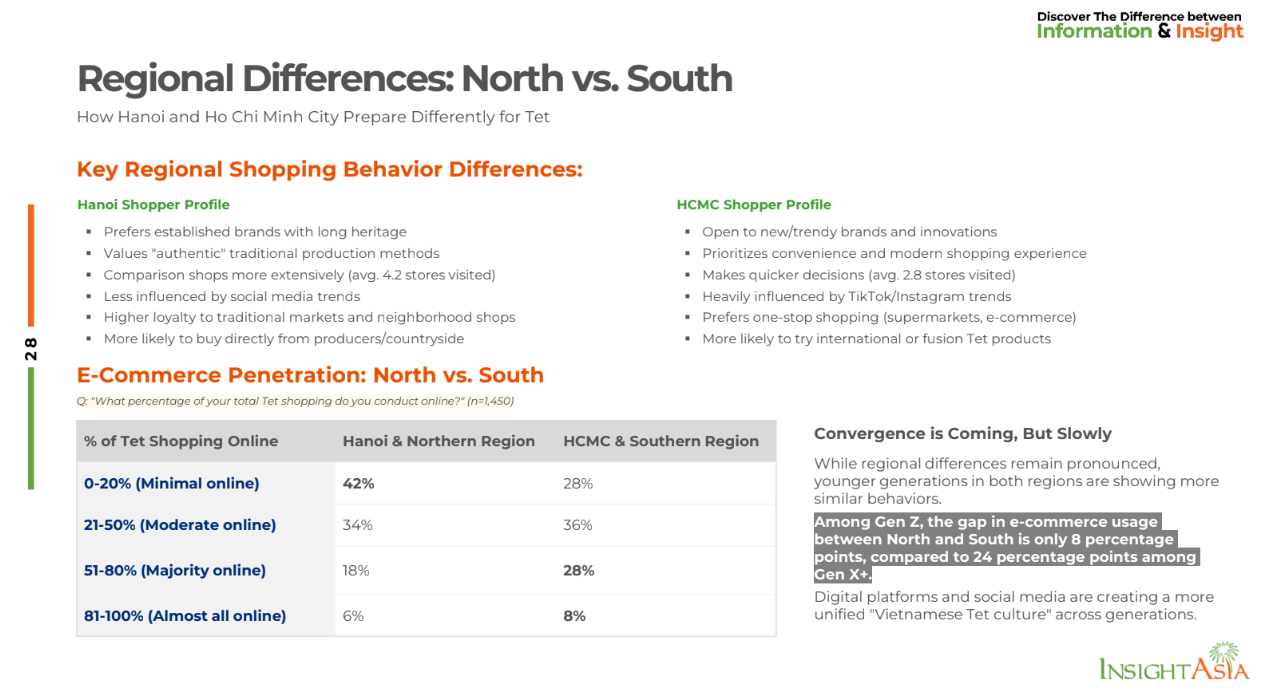
In terms of decision-making, Hanoi shoppers tend to be more deliberate, visiting an average of 4.2 stores before purchasing, while consumers in Ho Chi Minh City decide faster, with only 2.8 stores on average. However, regional differences are narrowing across generations. Among Gen Z, the gap in e-commerce usage between North and South has fallen to just 8 percentage points, compared to 24 points among Gen X and older groups. Overall, Northern consumers remain more oriented toward traditional values and long-established brands, while Southern consumers are more open to new brands, social trends, and modern retail experiences.
Implications for brands planning Tet 2026 marketing campaigns
Success during the Vietnamese New Year does not depend solely on the level of digitalization, but on a brand’s ability to balance modern convenience with cultural continuity. Brands should consider the following:
-
Optimize by category rather than spreading across channels: Not every product category fits every channel. Effective marketing strategies must align category dynamics with the right shopping environments. Digital payment initiatives should be deployed contextually rather than applied uniformly.
-
Design messages based on channel logic: Traditional markets, supermarkets, and e-commerce platforms serve different consumer expectations. A single message across all channels reduces effectiveness. Tet communication should also be localized by region, avoiding a one-size-fits-all national approach.
-
Focus on solutions, not just emotions: Tet 2026 reflects a more pragmatic celebration, where consumers seek to reduce effort and risk. Products, bundles, and services that save time and simplify decisions gain a clear competitive advantage.
-
Plan communication across the full Tet journey, not only peak days: As Tet preparation is divided into distinct phases, brands should appear early to guide and support planning, rather than concentrating spend right before the holiday. Budget and message allocation by phase improves ROI and increases the likelihood of brand consideration.
-
Measure and standardize with technology: Accurate data enables precise budget reallocation, protects brand integrity, and sustains consumer trust. Brands should standardize UTM tracking, deploy server-side tracking or Conversion APIs, build performance dashboards by channel, and continuously update consent and privacy policies.
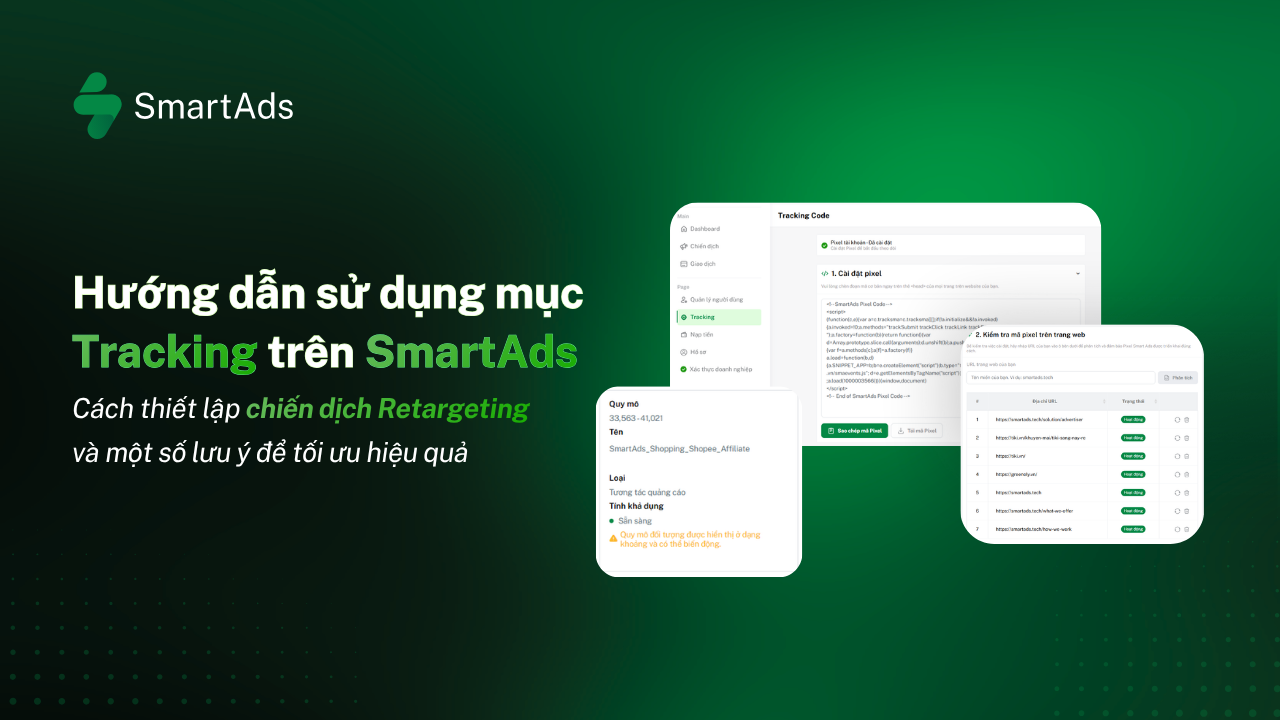
>>> Learn how to set up UTM tracking and SmartAds Pixel here.
In the broader picture, Tet 2026 reflects a fast-moving market shaped by evolving consumer behavior, yet anchored by enduring cultural values. These cultural anchors continue to define how consumers in Vietnam make choices, allocate retail spending, and embrace innovation in future Vietnamese New Year seasons.