1. What is website traffic? Key metrics and classification
1.1. Website traffic definition and main categories
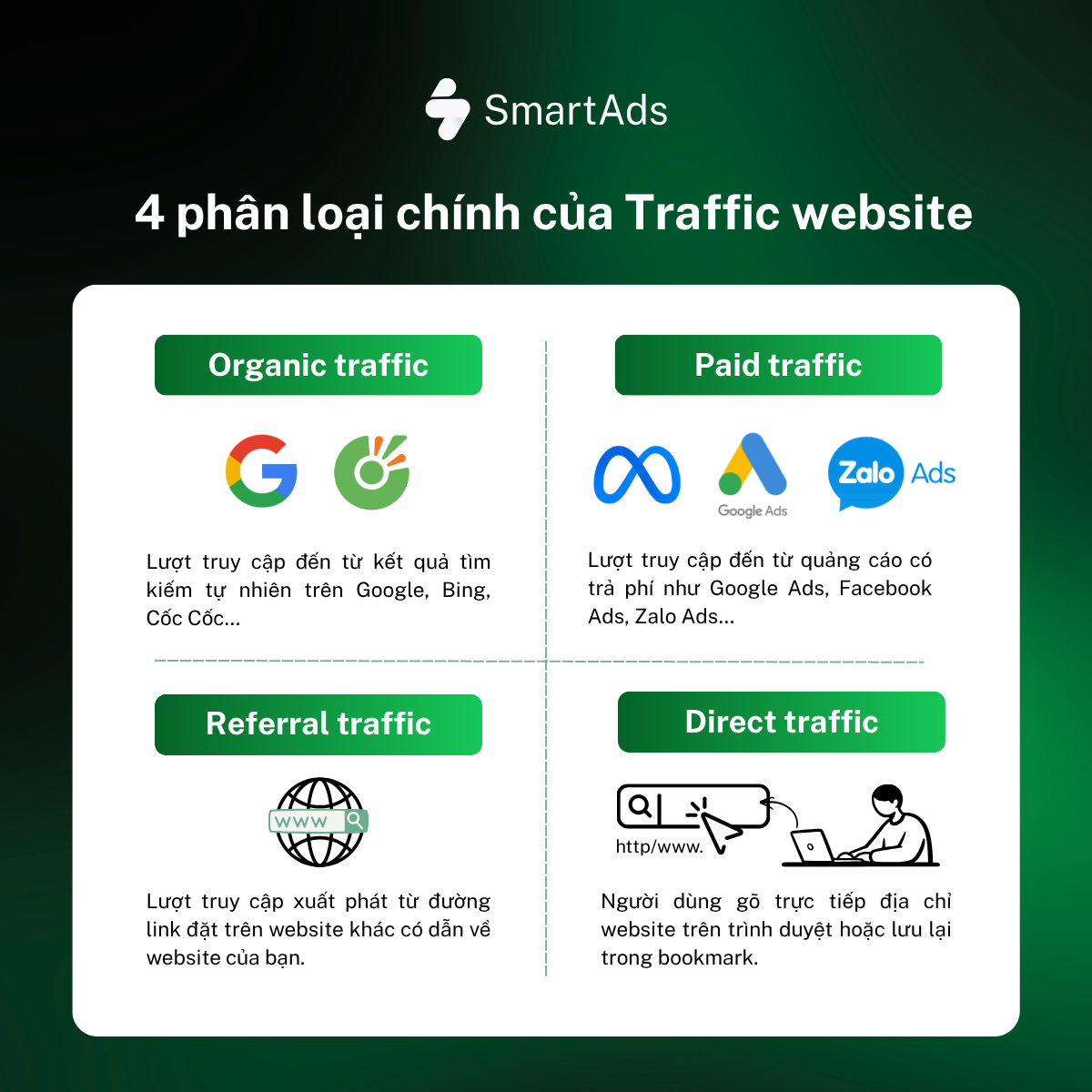
What is traffic? In digital marketing, website traffic refers to the total number of visits a website receives within a specific period. Traffic reflects user interest, brand awareness, and engagement with the products or content a business provides. Website traffic is typically divided into four primary categories:
-
Organic traffic: Visits generated from unpaid search engine results on platforms like Google, Bing, or Cốc Cốc. For example, a user searches “how to increase website traffic” and clicks on a top-ranking result.
-
Paid traffic: Visits driven by paid advertising channels such as Google Ads, Facebook Ads, or Zalo Ads.
-
Referral traffic: Visits originating from links placed on external websites or forums, such as product reviews linking back to your site.
-
Direct traffic: Users who access your website by typing the URL directly into the browser or via bookmarks.
Beyond these four primary groups, traffic can be further segmented into additional categories such as:
-
Social traffic: Visits from social media platforms like Facebook, Instagram, YouTube, TikTok, LinkedIn, or Twitter.
-
Email traffic: Visits generated through links in email marketing campaigns.
These traffic sources are typically analyzed alongside key performance metrics such as: Visits (total sessions), Unique Visitors (distinct users), Time on Site, Bounce Rate, and Conversion Rate. Together, they form the foundation of any effective website traffic optimization and sustainable SEO strategy.
1.2. Difference between traffic and visitors
Many marketers often confuse traffic with visitors. Traffic represents the total number of visits, while visitors refer to the actual number of users. A single user can visit multiple times, increasing traffic but still counted as one visitor.
For example, if you visit a website three times in one day, it records three visits (traffic) but only one visitor.
1.3. Key benefits of increasing website traffic
-
Enhance brand visibility and market reach
Higher traffic increases brand exposure, helping businesses expand into new audience segments. A well-optimized website also strengthens credibility and unlocks opportunities in potential markets. -
Boost conversions and leverage customer data
High-quality traffic improves conversion rates (sign-ups, purchases, lead generation). At the same time, businesses can collect behavioral data to personalize user experiences and optimize marketing performance. -
Build communities and amplify brand reach
Consistent traffic lays the foundation for a loyal customer base, enabling organic brand advocacy and reducing long-term advertising costs. -
Leverage traffic for cross-channel retargeting
Website traffic enables businesses to re-engage non-converting users across multiple platforms. With SmartAds, audiences can be segmented by behavior (product views, cart abandonment, blog reads, etc.) and activated with tailored campaigns and personalized messaging to improve return visits and conversions.
2. Key factors that drive effective website traffic
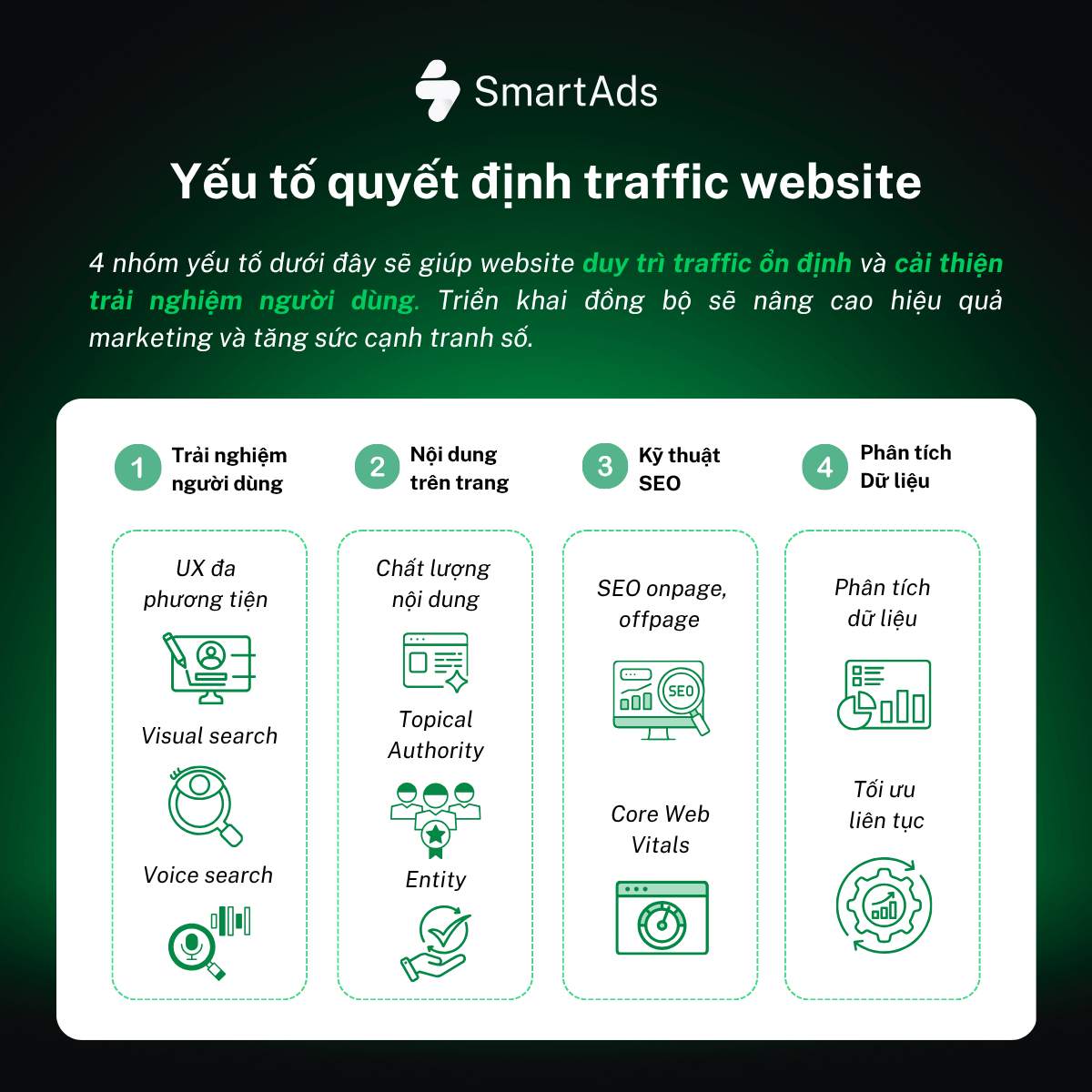
2.1. Content quality, topical authority, and entity-based SEO
High-quality content structured around topic clusters is essential for sustainable organic traffic growth. When a website builds comprehensive coverage within a specific domain, search engines like Google recognize its topical authority and prioritize it in search results.
Another increasingly important factor in modern SEO is Entity-based optimization. Instead of focusing solely on keywords, search engines now interpret meaning and relationships between entities. Entities help define who or what your content is about and how topics are interconnected, improving both ranking potential and credibility.
Therefore, content development should go beyond traditional SEO writing and include:
-
Using semantic keywords and semantic content
-
Building contextual internal linking structures
-
Applying schema markup to enhance search engine understanding
-
Maintaining consistent entity signals (brand, author, topic)
Combining topic clusters, entity SEO, and multi-format content (blogs, infographics, videos, podcasts, and even AR/VR where relevant) helps improve search engine comprehension, increase on-site engagement, and amplify multi-channel distribution.
2.2. On-page, off-page SEO and Core Web Vitals as the foundation
-
On-page SEO: Optimize content structure, keywords, meta tags, mobile responsiveness, internal linking, and schema markup to improve search engine understanding.
-
Off-page SEO: Focus on building high-quality backlinks and strong social signals.
-
Core Web Vitals optimization: Ensure optimal page speed (LCP), interactivity (FID), and visual stability (CLS) to maintain rankings and enhance user experience.
2.3. Multimedia UX, visual search, and voice search trends
Fast-loading, visually engaging interfaces combined with multimedia content such as videos, animations, and interactive formats help increase dwell time and reduce bounce rates. Notably, visual search (with over 1 billion daily recognitions via Google Lens) and voice search (used by 55% of internet users) present significant growth opportunities for marketers.
2.4. Data analytics and continuous optimization
Leveraging tools like Google Analytics and Search Console enables marketers to track real user behavior, identify strengths and weaknesses, and continuously refine website traffic strategies.
3. Effective strategies to increase website traffic
3.1. Holistic SEO strategy (on-page + off-page + entity)
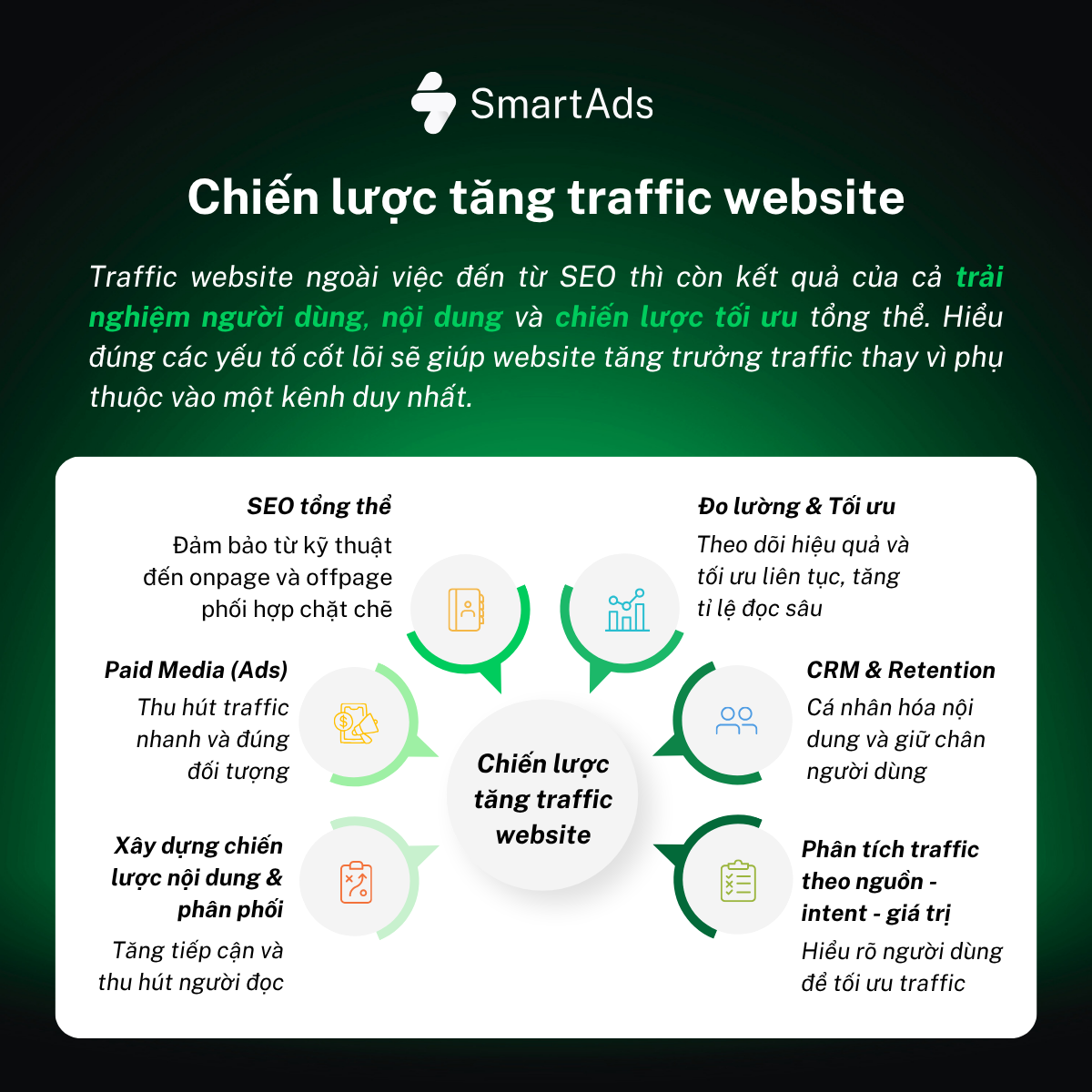
SEO is the foundation for sustainable organic traffic growth without relying heavily on paid advertising budgets.
Implementation approach:
On-page:
-
Optimize website structure (URL, breadcrumb, internal linking)
-
Create SEO-friendly content with primary and semantic keywords, clear headings (H1–H3), and scannable layouts
-
Enhance user experience: page speed (Core Web Vitals), mobile-first design, readability, and conversion optimization
Off-page:
-
Build high-quality backlinks via guest posts, media placements, and authoritative blogs
-
Prioritize link quality over quantity, avoiding spammy practices
Entity SEO:
-
Align brand signals across platforms: Google Business, social channels (Facebook, LinkedIn, etc.)
-
Implement structured data (Organization, Article schema)
Topical authority:
-
Build topic clusters: one pillar page supported by multiple related articles
-
Cover the full user search journey
3.2. Paid media (ads)
Paid media enables businesses to scale traffic quickly, target precisely, and measure performance clearly, making it especially effective for campaign-driven growth.
Implementation approach:
-
Google Ads: Search Ads capture existing demand, while Display supports remarketing
-
Social Ads (Facebook, Zalo, TikTok): Target users based on behavior, demographics, and retarget engaged audiences
-
Brandformance strategy: Combine branding (awareness, video) with performance (traffic, conversions)
-
Landing page optimization: Align messaging with ads, ensure clear CTA, and fast loading speed
3.3. Content and distribution (content + social + KOL)
Content is the asset, while distribution is the lever that ensures it reaches the right audience.
Implementation approach:
Content:
-
Develop a diversified content ecosystem: SEO blogs, videos (TikTok, YouTube), infographics, carousels, ebooks, and in-depth resources
-
Focus on solving specific user insights and delivering real value (education, guides, case studies)
Distribution:
-
Social media: Facebook, TikTok, LinkedIn, Threads; repurpose one content into multiple formats
-
Seeding: industry groups and niche communities
KOL/Influencer: product reviews, experience sharing, and driving traffic back to the website
3.4. CRM and retention (email + automation)
Beyond acquiring new traffic, businesses must retain and reactivate existing users to maximize overall performance.
Implementation approach:
-
Data collection: Signup forms, free ebooks/resources, events, and webinars
-
Email marketing: Regular newsletters and behavior-based personalized content
-
Automation: Welcome sequences, remarketing emails, upsell and cross-sell flows
-
Funnel building: Awareness, consideration, conversion, and loyalty stages
3.5. Measurement and optimization
This is the backbone that ensures strategies are driven by data rather than assumptions.
Implementation approach:
-
Analytics tools: Google Analytics, user behavior tracking, Google Search Console for SEO performance, heatmaps (Hotjar) for on-page insights
-
Key metrics tracking: Traffic by source (organic, paid, social), bounce rate, session duration, conversion rate
-
Continuous optimization: A/B testing for landing pages and CTAs, updating low-performing content, optimizing ad campaigns based on data
3.6. Analyzing traffic by source, intent, and value
Increasing traffic is just the first step. To maximize effectiveness, businesses must go beyond volume and analyze traffic at a deeper level through three layers: Source – Intent – Value.
3.6.1. Identify traffic sources and user intent
-
Organic: active search intent
-
Paid: demand generated through ads
-
Referral/Social: influenced by content or communities
-
Direct: users with existing brand awareness
Each traffic source carries a different level of conversion readiness, requiring tailored content strategies and landing pages.
3.6.2. Understand the conversion journey (SEO funnel)
Effective traffic must go beyond clicks and move through key stages:
-
Impression
-
Click
-
Intent fulfillment
-
Conversion
If user intent is not satisfied, even high traffic volumes will not generate meaningful value.
3.6.3. Evaluate traffic quality over vanity metrics
Traffic analysis helps businesses identify issues such as algorithm-driven drops, seasonal fluctuations, technical errors, or declining page performance—enabling timely and data-driven optimization decisions.
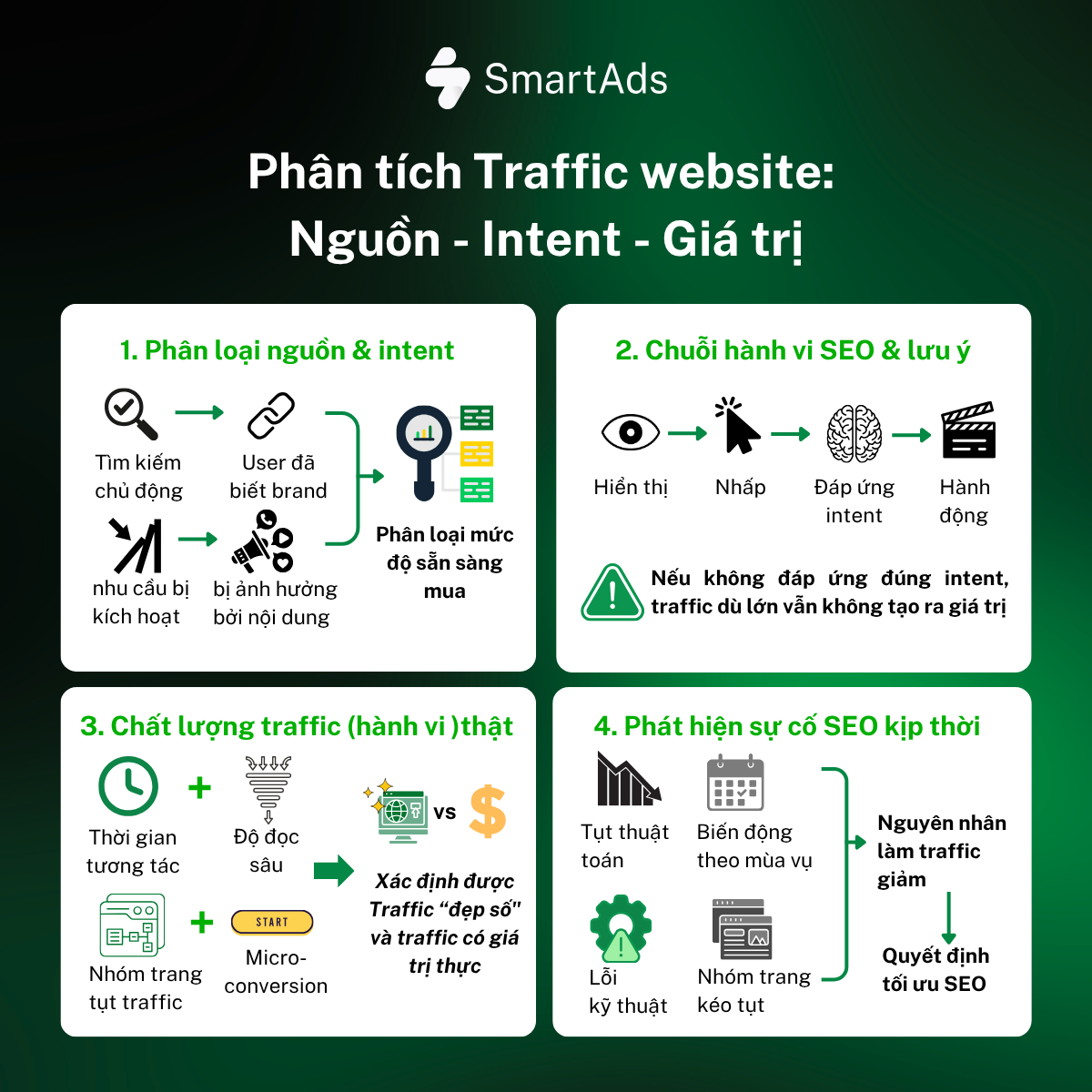
3.6.4. Identify SEO issues and optimize proactively
Traffic analysis enables businesses to clearly detect issues such as algorithm-related declines, seasonal fluctuations, technical website errors, or underperforming page groups. These insights allow for timely, precise optimization decisions instead of relying on intuition.
*Key notes for optimizing and increasing website traffic:
-
Avoid black-hat SEO techniques, fake traffic, or fraudulent traffic purchases, as they can result in severe penalties from Google and other platforms, damaging brand credibility.
-
Invest in analytics tools like Google Analytics and Search Console, combined with CRM systems to track user behavior and optimize conversion flows.
-
Continuously update knowledge on Google algorithms, AI advancements, and experiment with new personalization tools to maintain competitive advantage.
Conclusion
Traffic is not just about visits—it is the foundation for growth and conversion when leveraged effectively. To achieve sustainable traffic growth, businesses must integrate SEO, Ads, Content, CRM, and data strategies rather than operating in silos. With SmartAds, businesses can scale high-quality traffic through performance-driven advertising campaigns while receiving expert guidance on analytics tools like Google Analytics to monitor and continuously improve results. Create your SmartAds account to start building an effective website traffic strategy here.