1. CRM – Customer relationship management
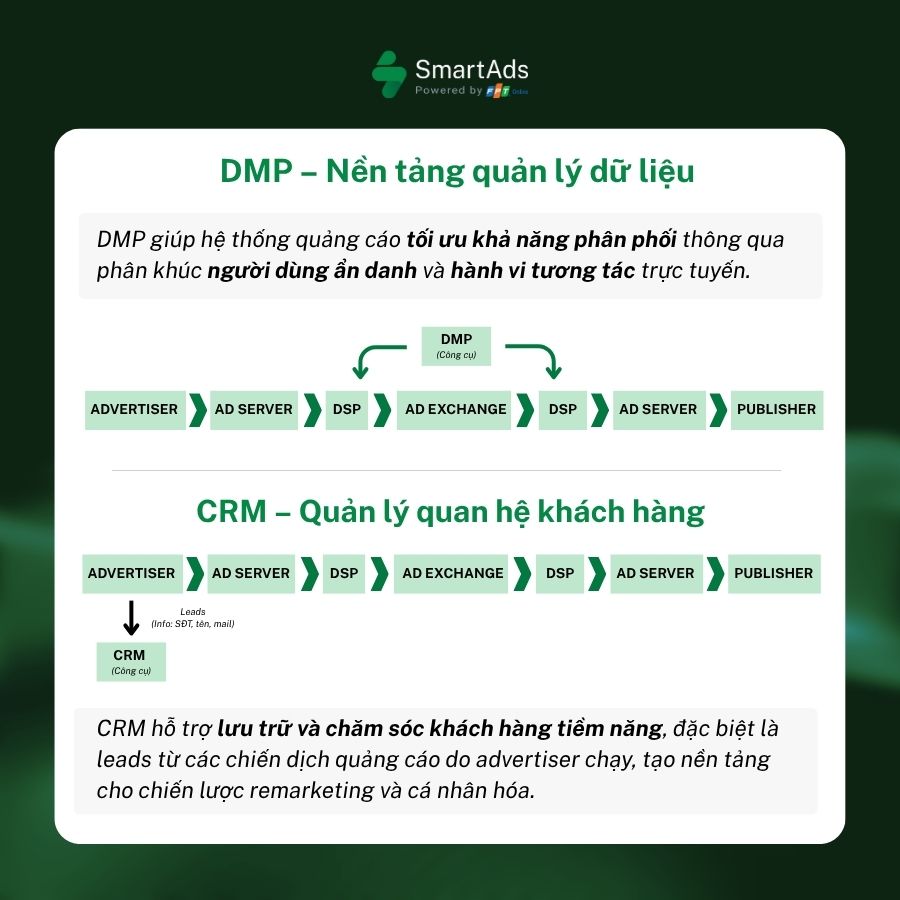
CRM (Customer Relationship Management) is a system designed to manage and nurture customer relationships. Its greatest strength lies in storing and tracking leads as identifiable customer data, based on interaction behaviors that include shared information and transaction history such as names, email addresses, phone numbers, purchase history, support tickets, and notes from the sales team.
Example: When a customer leaves their email to subscribe to a newsletter, the CRM system automatically records that lead, tags it as “potential,” and logs interaction history (emails opened, links clicked) before passing it to the sales team for follow-up.
Key applications of CRM:
-
Managing the sales pipeline and tracking each lead and customer across different stages.
-
Nurturing and engaging existing customers as well as leads that have not yet converted.
-
Measuring sales team performance based on conversion rates from leads to customers.
2. CDP – Unified customer data platform
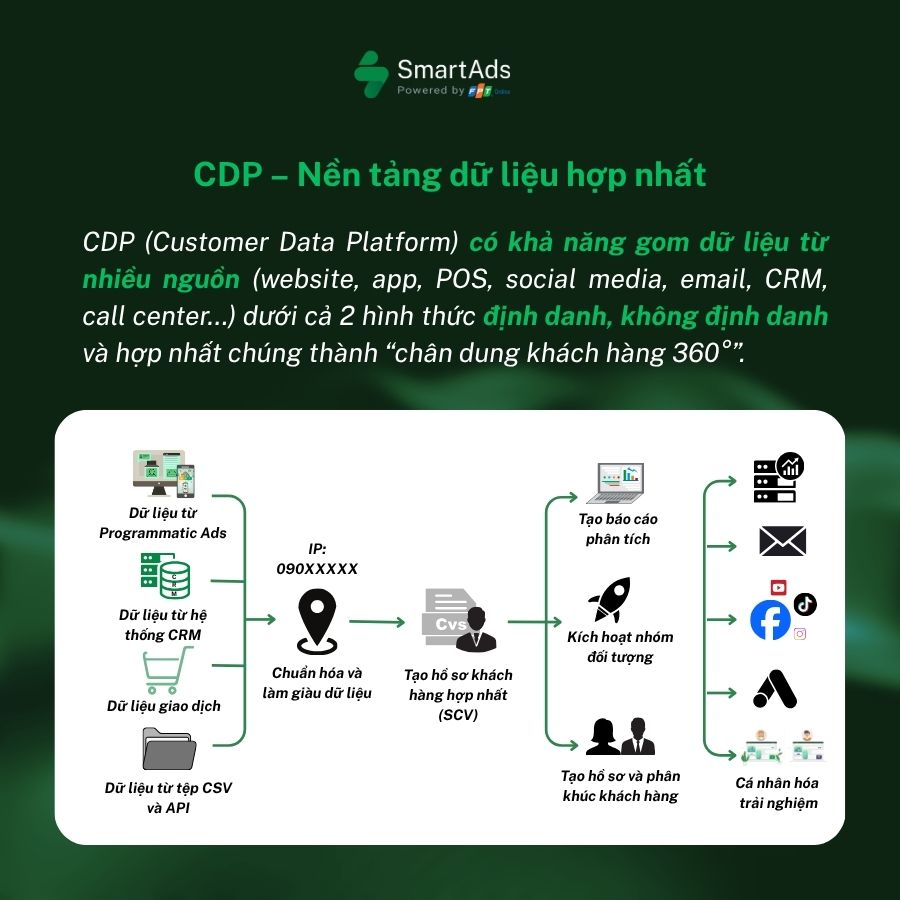
CDP (Customer Data Platform) is often described as the “marketing data brain” of an enterprise. A CDP can aggregate data from multiple sources (websites, apps, POS systems, social media, email, CRM, call centers, etc.), across both identifiable and non-identifiable data, and unify them into a “360-degree customer profile.”
Example: A cosmetics retail chain implements a CDP to consolidate data from:
-
Offline in-store purchase history.
-
Product views and cart abandonment behavior on the website.
-
Engagement with email and messaging campaigns.
Key applications of CDP:
-
Customer segmentation (e.g. VIP customers, churn-risk customers, high-potential leads).
-
Personalized marketing messages across email, SMS, and push notifications.
-
Advanced analytics of metrics such as Customer Lifetime Value (LTV) and churn rate.
3. DMP – Data management platform
DMP (Data Management Platform) helps businesses collect, aggregate, and analyze anonymous user data from external sources such as cookies, IP addresses, and devices. DMPs primarily handle third-party data and do not store personally identifiable information (PII). Advertisers use DMPs to build target audiences and optimize marketing performance by gaining insights into user behavior, interests, and demographics.
DMPs are especially suitable for businesses or agencies running large-scale display advertising and media buying. For companies focused on performance marketing, DMPs enable precise audience targeting across platforms such as Google, Facebook, or DSPs. In broad-reach campaigns, DMPs leverage third-party data to expand reach and retarget users unfamiliar with the brand. However, a key limitation of DMPs is their lack of identifiable customer data, which restricts deep personalization and typically limits segmentation to anonymous audiences.
Example: A premium real estate brand wants to reach users who frequently read content about “home buying” or “real estate investment” across multiple news sites. The DMP aggregates these behavioral signals into a segment and feeds it into advertising platforms, ensuring ads are shown only to users with relevant interests.
Key applications of DMP:
-
Collecting and categorizing anonymous data (cookies, device IDs).
-
Building audience segments for advertising campaigns.
-
Enabling advertisers to target audiences more accurately across multiple channels.
4. Comparison and relationship between CRM, CDP, and DMP
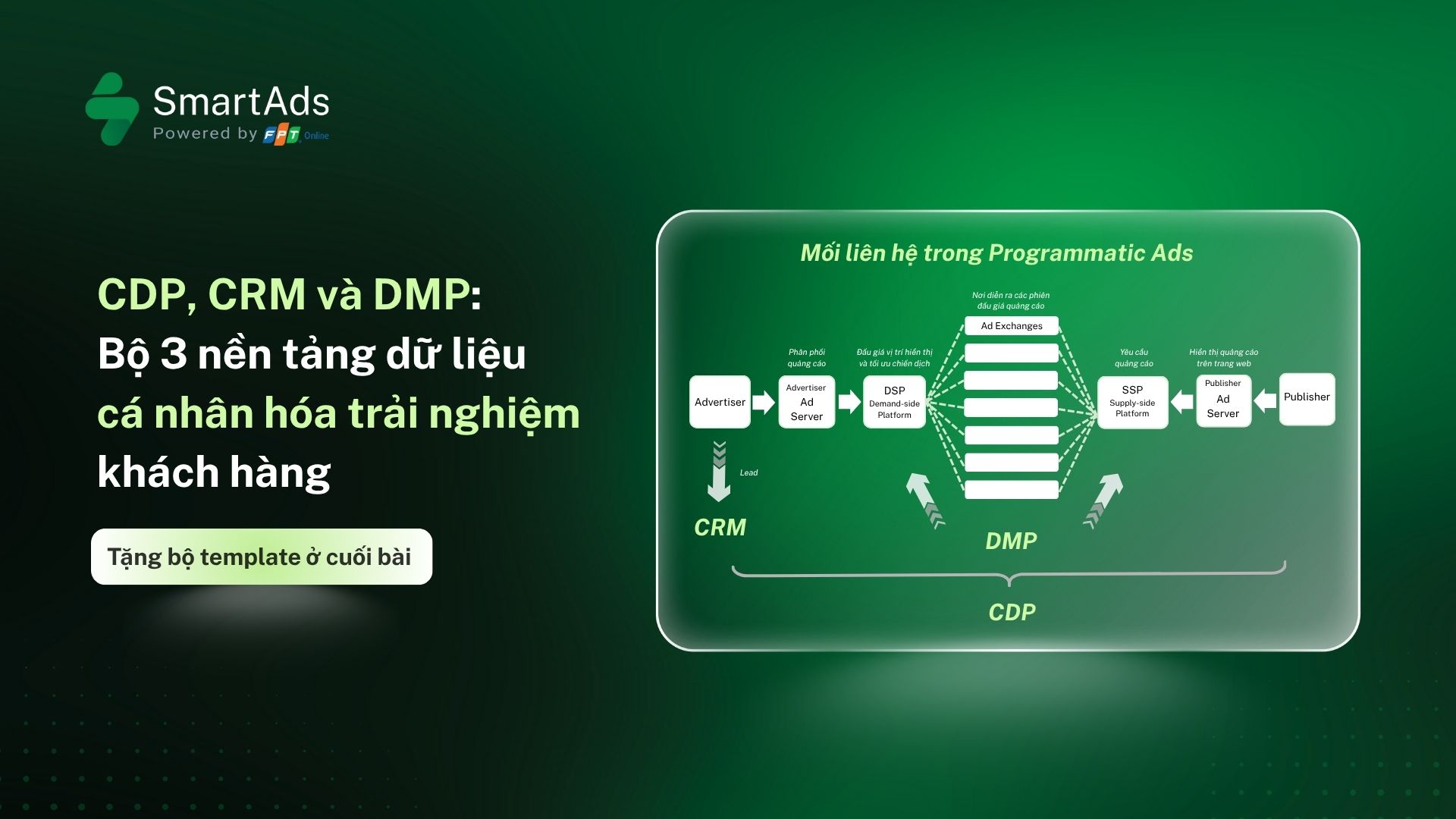
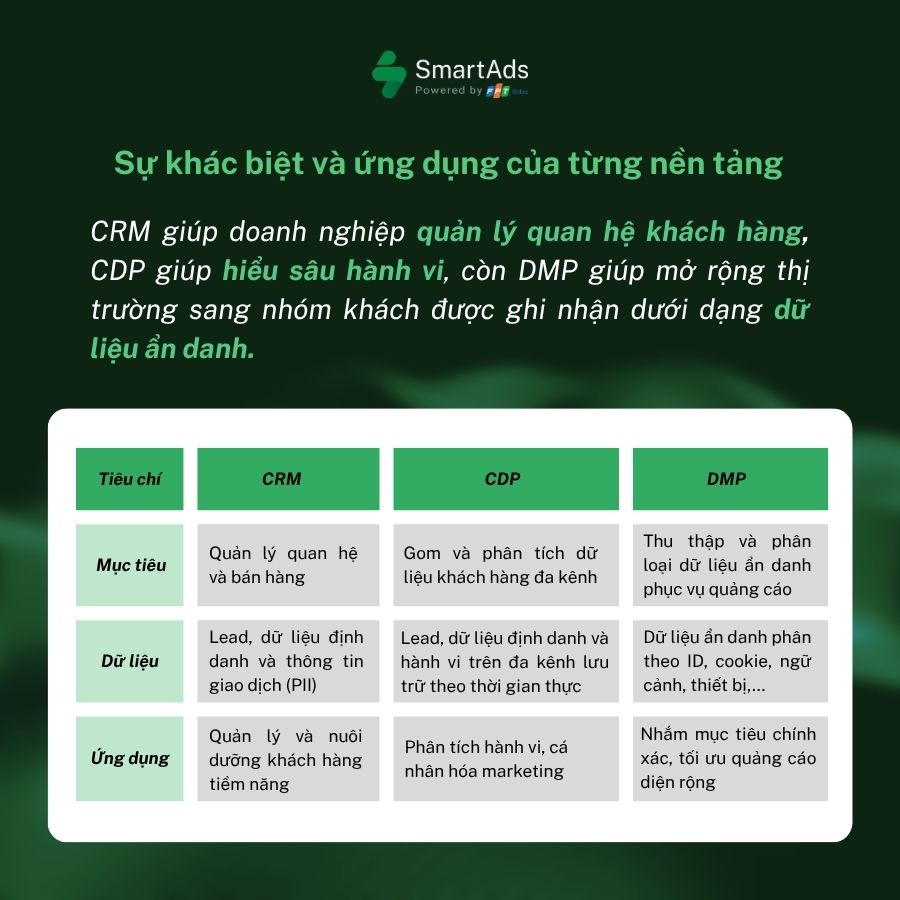
Within the marketing data ecosystem, CRM, CDP, and DMP are often mentioned together because they all relate to collecting, managing, and activating customer data. However, each platform serves a distinct purpose along the marketing journey—from relationship management and behavioral analysis to audience expansion. In other words, they are complementary pieces of the same data puzzle, helping businesses better understand and engage customers.
The table below highlights the differences and roles of each platform:
In practice, these three systems do not operate in isolation but work together as an integrated ecosystem within a holistic marketing strategy:
-
CRM ↔ CDP: CRM provides identifiable and transactional data, while CDP enriches it with online and offline behavioral data to complete the customer profile.
-
CDP ↔ DMP: CDP creates detailed customer segments (e.g. “users who bought red lipstick but not skincare”), which can then be synced to DMPs for anonymous audience expansion or targeted ad activation.
-
CRM ↔ DMP: Direct integration is limited, but CRM data can flow through CDP before being activated in DMPs for advertising purposes.
For example, CRM records that Customer A purchased a car three years ago. CDP adds insight that this customer has recently been researching electric vehicles on the website. The business then creates a segment “existing customers interested in EVs” in CDP and expands it via DMP to reach similar users, running electric vehicle banner ads on online news platforms.
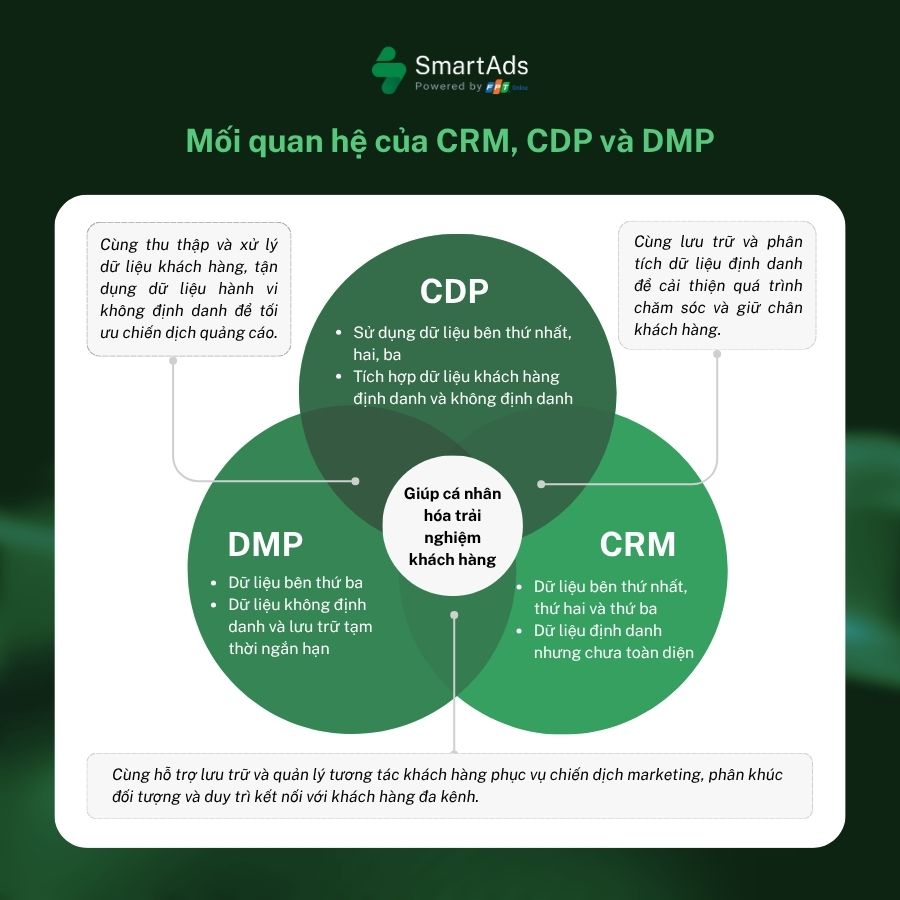
In summary, CRM focuses on managing customer relationships, CDP enables deep behavioral understanding, and DMP helps expand reach to anonymous audiences at scale.
5. Current Trend: The “Cookieless” era and the role of customer data
As major browsers such as Chrome, Safari, and Firefox gradually phase out third-party cookies, the digital advertising industry is entering the “cookieless” era —a period in which personal data can no longer be easily collected or shared. Instead of relying on cookies to track user behavior, brands and advertisers must build more resilient data strategies based on first-party data.
To adapt, businesses need to:
-
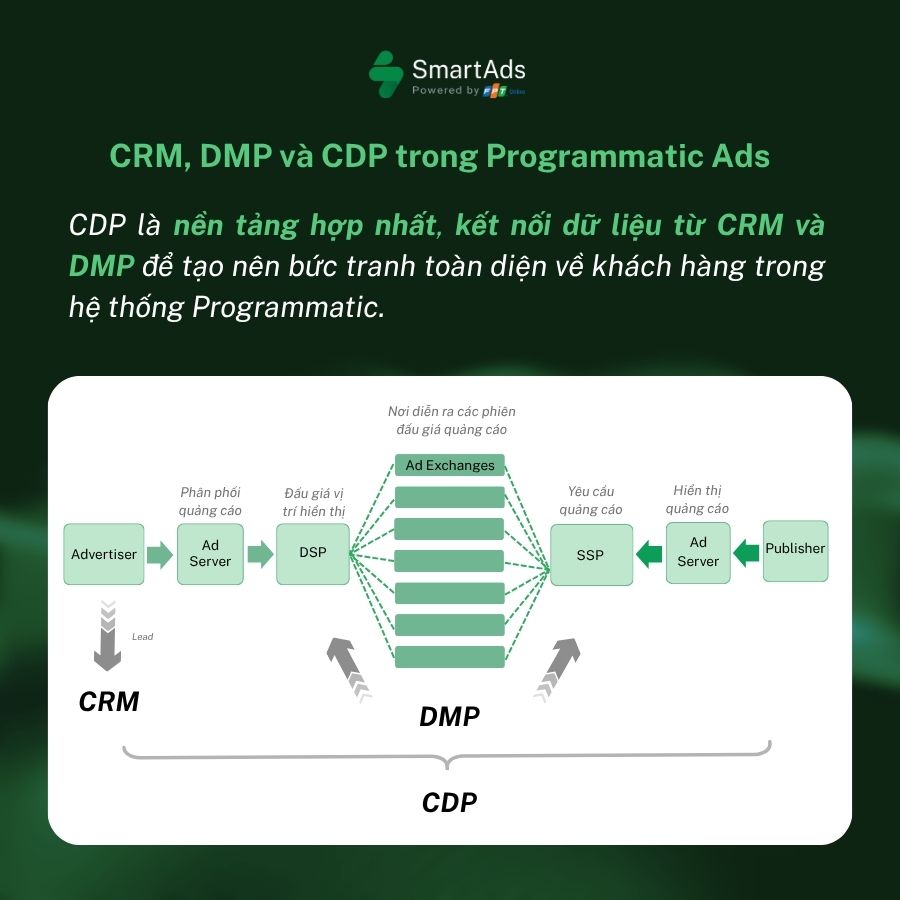
Build centralized data management systems (CRM, CDP, DMP) to unify data from multiple sources, enabling accurate lead identification and segmentation based on interest level and engagement behavior.
-
Create a clear value exchange (exclusive offers, personalized content, loyalty programs) to encourage customers to voluntarily share data, forming high-quality lead pools.
-
Apply AI and machine learning to analyze behavior, perform lead scoring, identify qualified leads, predict conversion likelihood, and optimize nurturing strategies.
>>> What is lead generation? How to apply lead scoring to classify potential customers?
-
Ensure compliance with data privacy regulations to build trust and encourage customers to share accurate, long-term information.
Conclusion
CRM, CDP, and DMP are three foundational platforms in customer data management, enabling businesses to manage relationships, gain deep behavioral insights, and scale audience reach. When orchestrated effectively, they form a comprehensive data ecosystem that optimizes every stage from acquisition and nurturing to conversion.
To adapt to the cookieless future, SmartAds offers a new approach to digital advertising—contextual advertising as an alternative to traditional cookie-based targeting. By analyzing article content and reading behavior, SmartAds enables brands to deliver messages in the right context, at the right moment, maintaining advertising performance while enhancing user experience and ensuring data privacy compliance.