Signs that your ads are not effective
Before identifying the root causes, you should first recognize the following warning signs:
-
No meaningful engagement: for example, very few likes, comments, messages, or add-to-cart actions—even though the ad may still generate impressions or clicks.
-
Low CTR (Click-Through Rate): this metric measures the ratio of clicks to impressions. A low CTR indicates poor advertising effectiveness, meaning your ad content is not compelling enough to motivate users to click.
-
Excessively high CPC (Cost per Click): you are paying for clicks, but the actual results and downstream performance remain weak.
-
Low conversion rate: after clicking or viewing the ad, users fail to complete the desired action (purchase, sign-up, form submission, etc.).

If key metrics such as engagement, CTR, CPC, and conversion rate all perform poorly, this is a clear signal that your entire campaign needs to be reviewed—from goal setting and channel selection to audience targeting, creative content, and messaging. Early detection allows you to optimize in time, avoid wasted budget, and increase the likelihood of achieving stronger advertising effectiveness.
8 key reasons why advertising campaigns underperform
1. Ads fail to clearly highlight customer benefits
Many campaigns fall into the trap of “saying something but saying nothing,” where messages are overly generic and products or services lack differentiation from competitors. This often happens because advertisers do not fully understand the product or market, resulting in unclear or poorly communicated USPs. As users scroll past without seeing a compelling reason to stop—because the message does not address their latent needs—they lack the motivation to click or engage. Purchase or sign-up intent is never activated, ad quality scores are downgraded by the algorithm, distribution is reduced, and the outcome is inevitably low CTR and low conversion rates.
Example: advertising an English course with the message “We guarantee you’ll get better” is not persuasive, as dozens of other centers make the same claim.
Solutions:
-
Analyze the market and customer personas: gain a deep understanding of the industry and competitors, and clearly define buyer personas as the strategic compass for your campaign.
-
Clearly define 1–2 strong differentiators versus competitors (e.g., time savings, cost reduction, extended warranty, exclusive features, limited-time offers).
>>> Latest guide on building buyer personas and defining target audiences.
-
Write headlines that directly address pain points or highlight concrete benefits.
-
Use visuals that demonstrate real value: authentic customer reviews and case studies.
-
Run A/B tests on headlines using the formula “Benefit → Promise → CTA” to identify the highest-performing version.
-
During optimization, monitor CTR, time on page, and bounce rate. Low CTR suggests weak headlines; short time on page or high bounce rate indicates the landing page is not meeting user expectations.
2. Incorrect targeting or audiences that are too broad or too narrow
One of the most common reasons for poor advertising effectiveness is incorrect targeting. When targeting is too broad, budgets are diluted and ads are shown to users with little to no interest. Seeing irrelevant ads, users quickly scroll past without clicking or engaging. Conversely, overly narrow targeting limits reach, preventing campaigns from accessing a large enough pool of potential customers to drive conversions. The result is restricted delivery, declining performance, and rising costs.
Example: running ads for mother-and-baby products while targeting only men aged 18–24 leads to impressions and clicks that generate little to no value.
Solutions:
-
Build clear personas for each customer segment (age, income, behavior, needs, and specific pain points).
-
Use data-driven segmentation: leverage lookalike audiences based on your best customers, and implement retargeting for users who have previously interacted with your brand or website.
-
Test multiple small audience groups (5–8 segments), compare performance, and scale budgets for the top-performing segments.
3. Weak ad creatives (Images, Videos, Content)
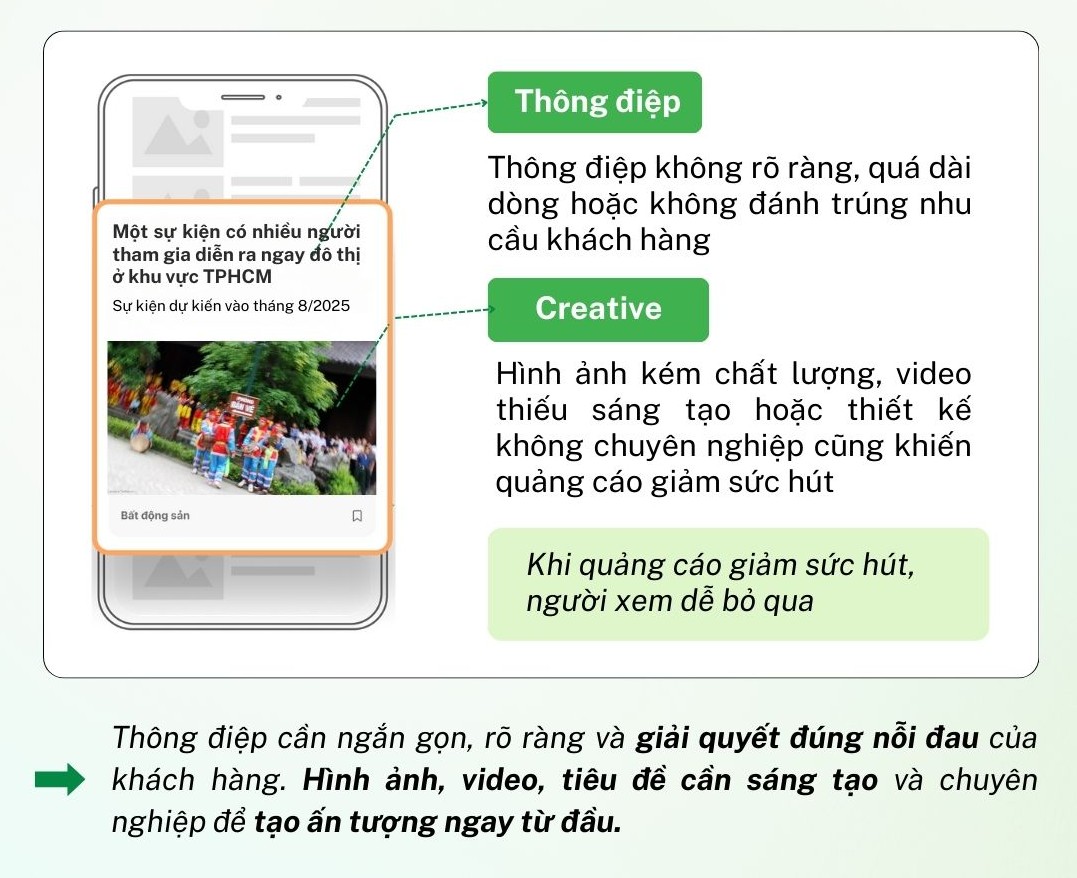
Even with accurate targeting, campaigns can still fail if creatives are not engaging. Blurry images, poor design, overly long videos, or headlines that fail to highlight benefits will cause ads to be ignored almost instantly. Creatives directly determine whether users stop to watch within the critical first few seconds.
Poor creatives lead to low CTR and weak engagement. As a result, ad algorithms deprioritize delivery, driving up impression and CPC costs.
Example: a 45-second video that opens with generic footage and lacks a strong hook is likely to be skipped after just 2–3 seconds.
>>> How should ads be designed when text occupies 20% of the banner?
Solutions:
-
Design creatives to make an impact within the first 1–2 seconds, delivering a clear and simple message.
-
For video, the first 3 seconds must include a strong hook: a thought-provoking question, attention-grabbing situation, or standout benefit.
-
Test multiple formats: static images, carousels, and short videos (6–15 seconds) to identify the most effective option.
-
Use captions and subtitles to optimize for users who watch videos with sound off.
-
Monitor CTR, view-through rate, and engagement (likes, comments, shares). Low CTR indicates weak creatives; low view-through rate suggests poor retention; low engagement shows the message lacks emotional appeal.
4. Vague or misaligned CTAs
An ad may generate views or even traffic to a landing page, yet still fail to convert if the CTA (Call-to-Action) is unclear. When messaging stops at generic prompts like “Learn more” while the goal is immediate sales, users become confused about the next step. This is a common mistake that results in “traffic without orders.”
In reality, even interested users need clear direction. A vague CTA leaves them stuck in the consideration stage without taking action, leading to high traffic but poor lead or sales generation.
Example: a major promotion campaign using “Learn more” instead of “Buy now – 20% off today,” resulting in lower overall campaign performance.
Solutions:
-
Align CTAs with campaign objectives:
-
Awareness → “Discover now,” “Explore more”
-
Lead generation → “Sign up for offers,” “Get a free consultation”
-
Direct sales → “Buy now – 20% off,” “Order today with free nationwide shipping”
-
-
Make CTAs prominent, concise, and benefit-driven (e.g., “Get a 100K discount now”).
-
Test CTA placement: within creatives, at the top of the landing page, or multiple touchpoints in long-form content.
-
Track click-to-action rate and conversion rate per CTA. High CTR but low conversion suggests mismatched expectations; low CTR indicates CTA wording or placement needs improvement.
5. Poorly optimized landing pages
Even if ads successfully drive clicks, all efforts can be wasted if the landing page is not optimized. Common issues include slow load speed, poor mobile experience, mismatched content versus the ad, or overly complicated conversion steps. These friction points often cause users to abandon immediately after clicking.
Modern users are highly impatient. If a page takes more than 3 seconds to load, they leave. If an ad promises “20% off” but the landing page shows only generic information, trust drops instantly. The result is high bounce rates, lost leads, and significantly lower conversion rates.
Example: an ad highlights “30% off for the first 100 customers,” but users must navigate multiple steps to find the offer or fill out a long form—leading to abandonment.

Solutions:
-
Optimize page load speed to ≤ 3 seconds, especially on mobile.
-
Ensure landing page content matches the ad 1:1: headlines, visuals, and offers must be consistent.
-
Reduce conversion friction: shorten forms, keep only essential fields, enable one-click purchase or auto-fill where possible.
-
Adopt a mobile-first design approach, as most traffic comes from smartphones.
-
Track bounce rate, page load time, and conversion rate. High bounce indicates unmet expectations; load times >3s require technical optimization; low conversion calls for layout or CTA review.
6. Lack of continuous tracking, analysis, and optimization
Many campaigns are left unattended after launch, with no data monitoring or adjustments. Over time, ads become repetitive, causing ad fatigue, declining CTR, and rising costs.
Solution: implement proper tracking (pixels, conversion APIs) and monitor performance regularly. After 3–5 days of sufficient data, pause underperforming variants and scale winning ones. Refresh creatives periodically to maintain freshness.
>>> Guide to setting up UTM tracking and SmartAds pixel.
7. Budgets and bidding not aligned with campaign goals
Budgets that are too low for algorithm learning, bids that are too low during competitive periods, or sudden budget changes that reset the learning phase can negatively impact performance in several ways:
-
Delivery: ads fail to reach potential audiences or are shown during ineffective time slots.
-
Data collection: insufficient conversion samples prevent proper optimization, resulting in unstable conversion rates.
Recommended actions (priority order):
-
Define a minimum budget for the learning phase to ensure enough data for optimization.
-
Use auto-bidding when data is limited; switch to manual or target CPA once benchmarks are established.
-
Adjust budgets incrementally to avoid resetting the learning phase.
-
Balance testing and scaling: allocate 10–20% of the budget for testing creatives or audiences, and scale the top-performing variants.
8. Lack of brand credibility or social proof
Many new brands underestimate the importance of building trust from the first touchpoints. Basic websites, minimal reviews, unclear contact information, or unresolved negative feedback can all raise doubts among users.
Without implicit trust signals, customer behavior is significantly affected—especially for high-value products. Users actively look for proof (reviews, ratings, case studies). When they find none, purchase decisions are delayed or abandoned, resulting in low conversion rates.
Solutions:
-
Show social proof: real customer reviews, concrete case studies, and measurable results.
-
Add trust signals: partner logos, certifications, awards, warranty or refund policies.
-
Optimize “About” and contact information: clearly display address, hotline, and email.
-
Use retargeting for nurturing: re-engage non-buyers with ads, email, or social content showcasing testimonials and reviews.
Conclusion — A quick checklist when ads underperform
In summary, poor advertising effectiveness often stems from unclear target audiences, unengaging content, lack of testing, incorrect channel or timing choices, and insufficient measurement and optimization. To improve results, businesses must build a continuous track – analyze – optimize process, combine multivariate testing (A/B testing), invest in high-quality content, and consistently build brand credibility. Only by addressing all bottlenecks holistically can advertising truly become a revenue-generating engine rather than a “budget-burning machine.” Below is a quick checklist for reference:
-
Have you clearly defined your USP?
-
Is your target audience clearly segmented and tested?
-
Does your creative include a hook within the first 1–2 seconds?
-
Is your CTA aligned with your campaign objective?
-
Does your landing page match the ad and load quickly?
-
Do you have proper tracking and a regular optimization schedule?
-
Are your budget and bids sufficient for algorithm learning?
-
Do you have enough social proof to reduce perceived risk?