This “threshold unlocking” mechanism makes cash flow management more complex, especially for businesses that need to reconcile accounting records for each deposit cycle. The amount spent does not necessarily equal the amount that can be invoiced, and the timing of charges is not entirely controlled by the advertiser. Meanwhile, some advertising systems operate on a simpler principle: what you deposit is exactly what you can invoice, with VAT already included in the price from the beginning. It is important to clearly distinguish between “spend” (the amount used when ads are delivered) and “deposit” (funds added to the advertising account), as these represent two different financial flows.
Because of these differences, understanding what a billing threshold is and how it impacts financial management is essential before selecting the most suitable advertising platform.
1. What is a billing threshold?
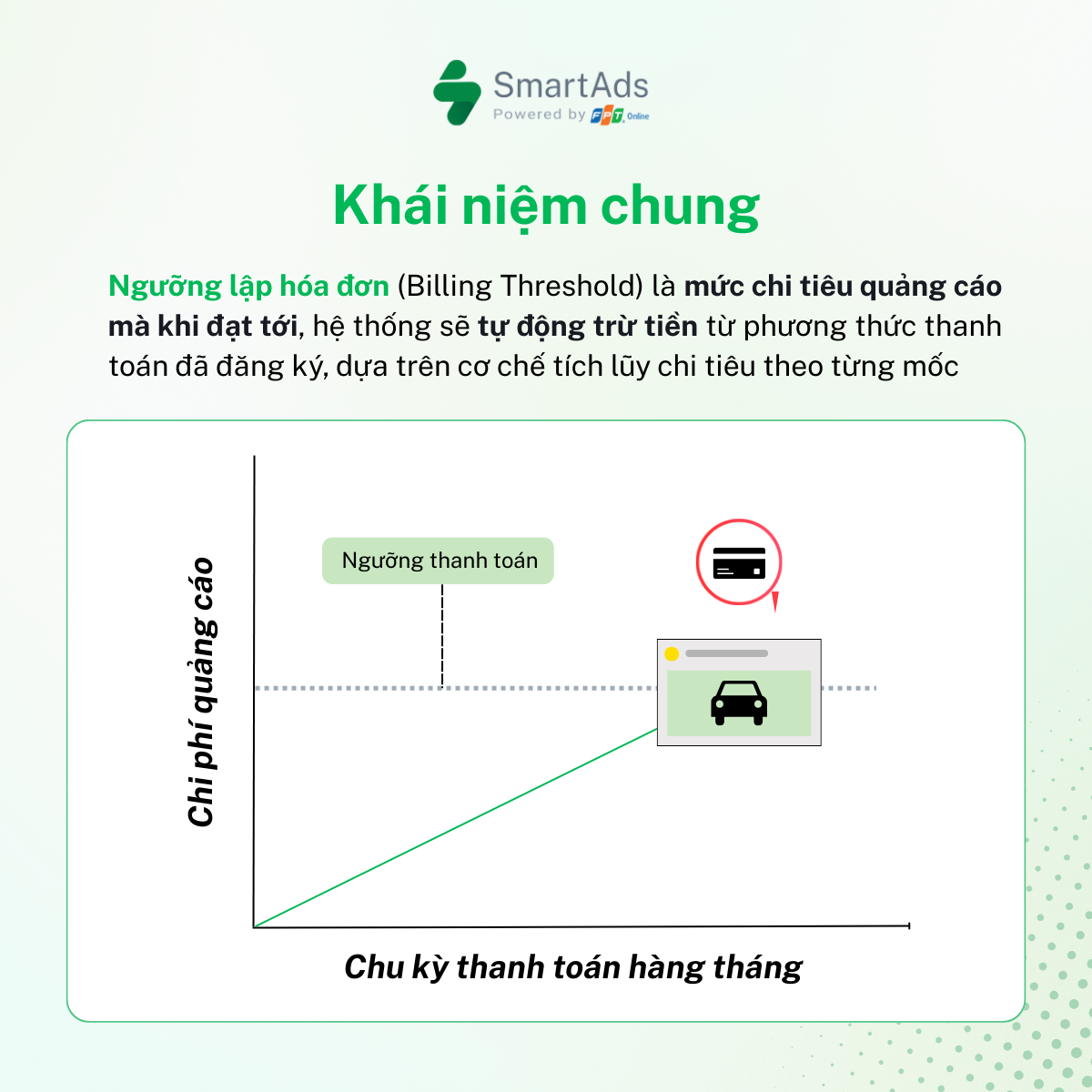
Billing threshold refers to the amount of advertising spend at which the system automatically charges the registered payment method (credit or debit card).
Example: If the account threshold is 2,000,000 VND, once total ad spend reaches that amount, the system automatically charges the card. Afterward, a new billing cycle begins again from 0.
2. How billing thresholds work
A billing threshold operates through a cumulative spending mechanism:
-
You launch advertising campaigns.
-
Costs gradually increase as ads are delivered.
-
Once the threshold is reached, the system automatically charges the payment method.
-
A new billing cycle begins.
Additionally, if the threshold is not reached during the month, the system may still charge the amount spent on the final day of the billing cycle.
3. Key characteristics of billing thresholds
3.1 Automatic payment
This is the most important feature because:
-
The system automatically charges your credit or debit card once the spending threshold is reached.
-
No manual payment action is required.
-
It prevents campaigns from being interrupted due to missed payments.
This is particularly beneficial for businesses running continuous advertising campaigns.
3.2 Cost control
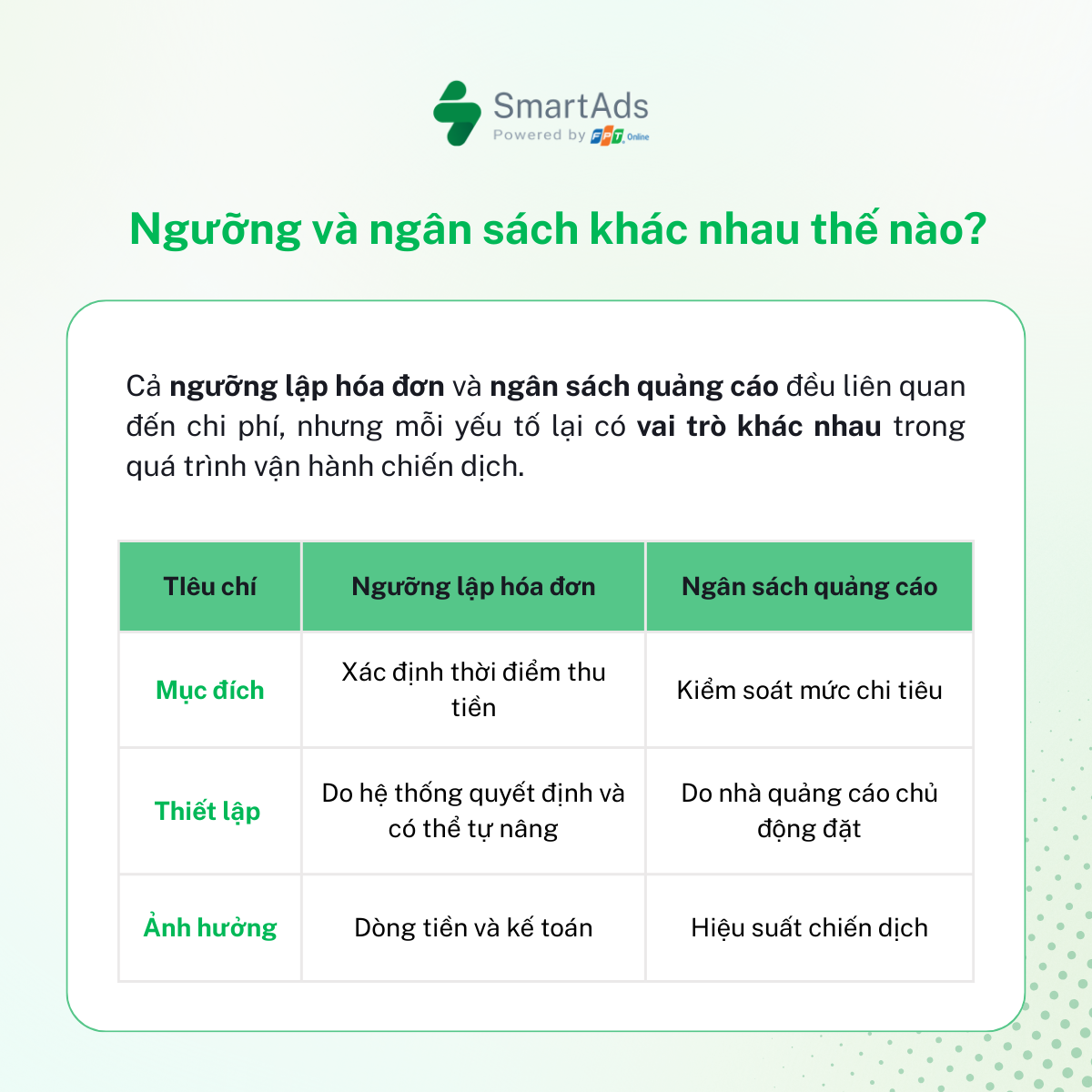
The billing threshold is commonly used in postpaid advertising models and acts as a “payment consolidation point” to avoid charging the account for every individual click or action.
During advertising campaigns, businesses may generate thousands of impressions, clicks, or conversions each day. If the system charged for every interaction, the number of transactions would be extremely large and difficult to track financially. Therefore, platforms only collect payments when spending reaches a predefined threshold or when the billing cycle closes. This mechanism reduces transaction frequency and streamlines accounting operations.
With the prepaid model used by SmartAds, businesses fund their advertising account in advance and spend within the available balance. As a result, there is no recurring billing threshold mechanism; invoices correspond directly to the deposited amount.
Understanding the differences between these two mechanisms helps businesses choose the most suitable model and optimize financial management processes more effectively.
3.3 Automatic threshold increase
When an account maintains a strong payment history, experiences no card errors, and consistently pays on time, the platform may automatically increase the billing threshold to higher levels. This reduces the number of charges during the month and reflects the account’s financial reliability within the system.
However, it is important to understand that a higher billing threshold does not guarantee absolute account security. Alongside the credit mechanism, platforms also operate automated risk control systems to detect unusual behavior, policy violations, or signs of fraudulent activity.
In some cases, even accounts with a strong payment history may still face spending restrictions, reduced thresholds, or temporary ad suspensions if the system detects potential risks. Platform notifications are often general in nature, making it difficult for businesses to determine the exact cause and resolution.
As a result, campaigns may be interrupted, the marketing plan may need sudden adjustments, and additional operational costs may arise if replacement accounts are required.
This is one of the common challenges when using postpaid advertising models that rely heavily on automated platform controls.
3.4 Charge timing
This is the part that often causes the most confusion. Businesses may be charged in two situations:
-
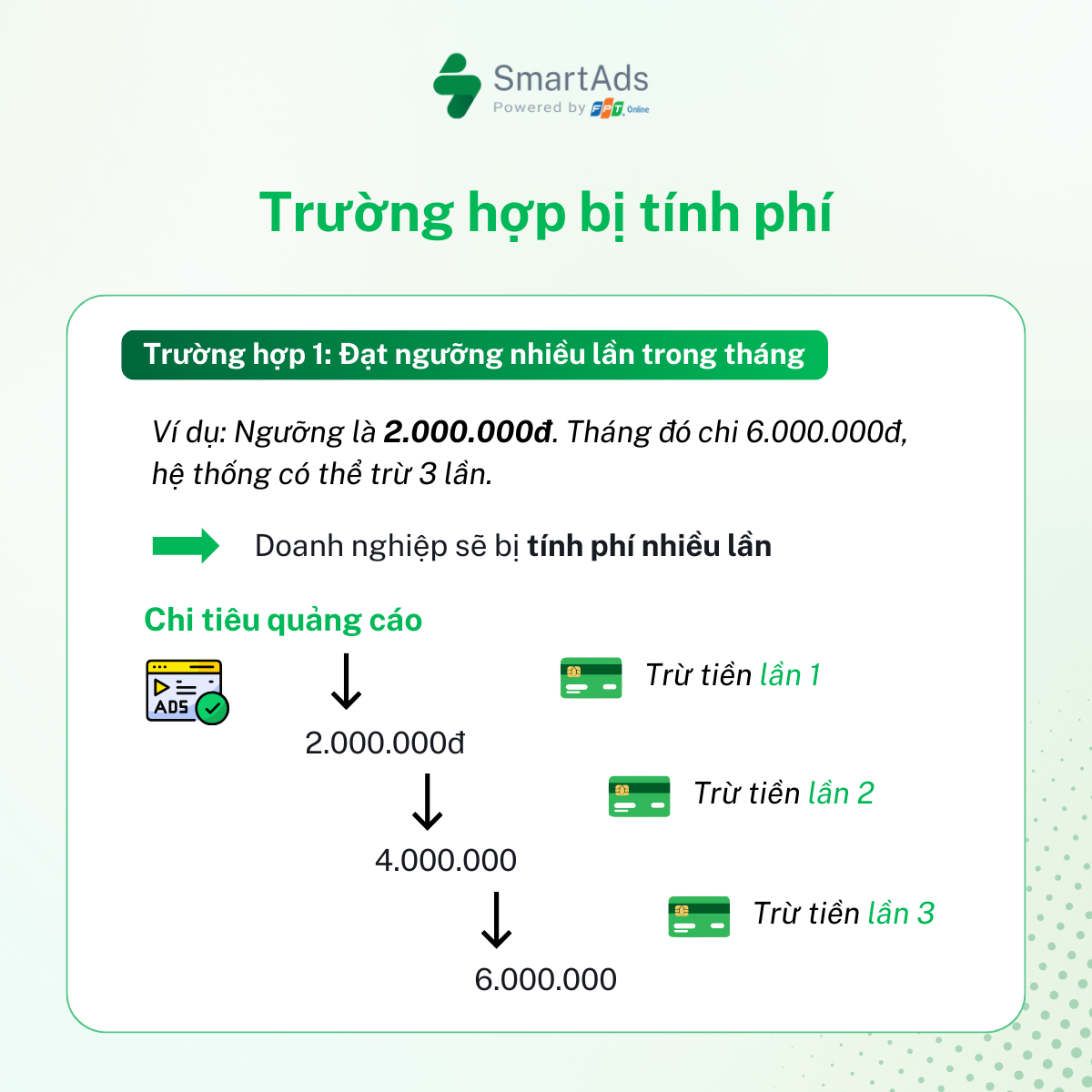
Case 1: The threshold is reached multiple times in a month
The account will be charged multiple times.
Example: If the threshold is 2 million VND and the monthly spend is 6 million VND, the system may charge the account three times.
-
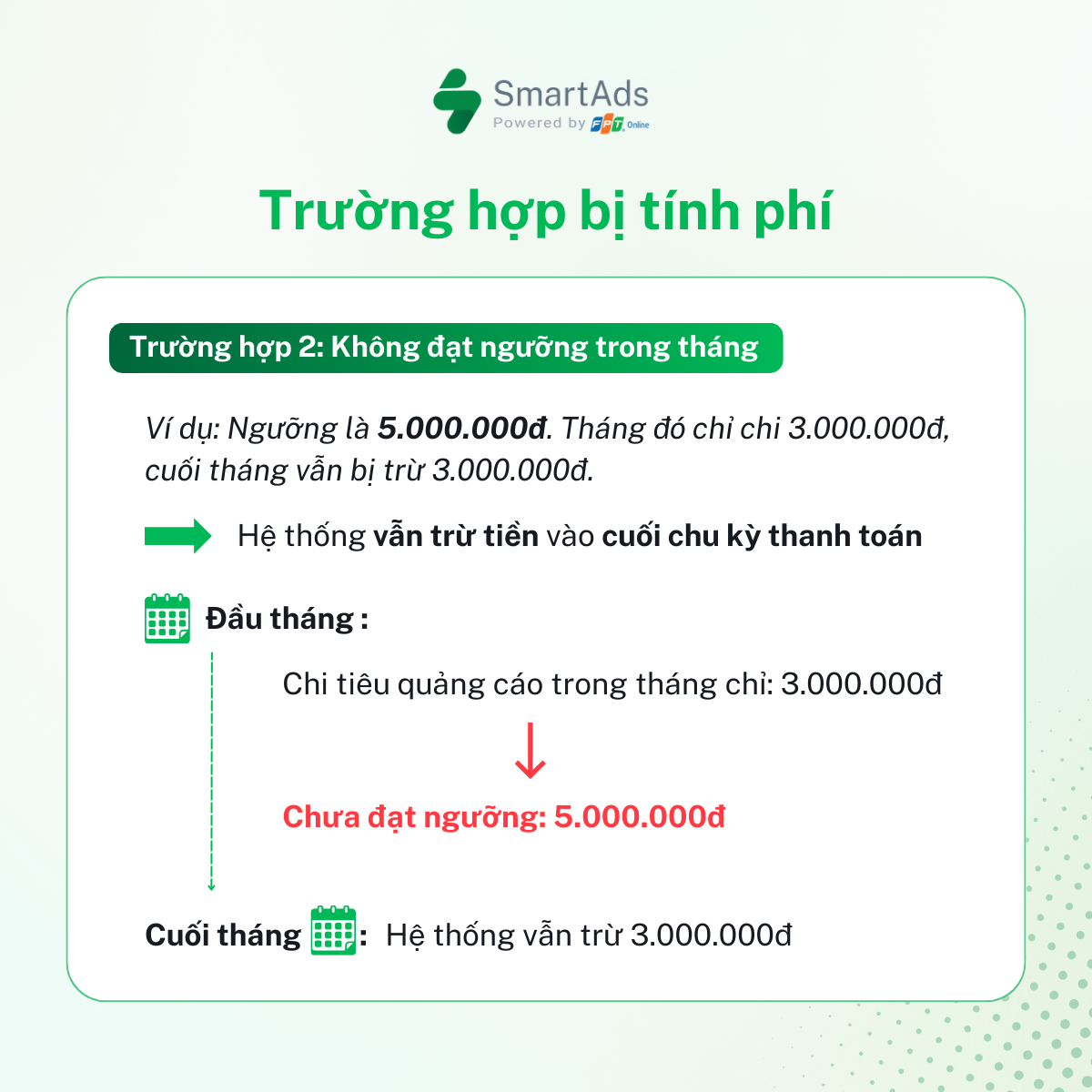
Case 2: The threshold is not reached within the month
The system still charges the amount spent at the end of the billing cycle.
Example: If the threshold is 5 million VND but the monthly spend is only 3 million VND, the system will still charge 3 million VND at the end of the month.
Essentially, this mechanism is designed to avoid excessive micro-transactions. However, for large businesses running multiple campaigns with high spending levels, reaching the threshold multiple times per month means multiple charges and multiple invoices. This can fragment accounting reconciliation processes. In contrast, with a prepaid model like SmartAds, businesses simply deposit once and receive an invoice for the exact deposited amount (VAT included), making financial management more streamlined and predictable.
4. Important considerations when using billing thresholds
-
Always monitor your card limit to avoid payment failures: Track your card limit and available balance to prevent rejected transactions while running ads, especially with postpaid accounts.
-
Do not confuse thresholds with budgets: The campaign budget is set by the advertiser, while the billing threshold is the platform’s charging mechanism.
-
Review threshold increase history to forecast future cash flow: This helps businesses anticipate monthly charges and optimize capital allocation.
-
Be aware of account recovery processes: When advertising accounts are restricted due to payment issues, international platforms often require multiple verification steps, appeals, and review rounds, which can take time. With SmartAds, businesses typically only need to verify valid information, allowing the recovery process to be completed much faster.
Conclusion
The billing threshold is an automated mechanism that allows advertising platforms to manage payments more flexibly. By understanding how the system calculates charges, how thresholds increase, and when payments are deducted, businesses can better control advertising budgets, cash flow, and campaign operations. However, if companies prefer not to rely on the “threshold unlocking” mechanism, avoid multiple deductions during the month, and minimize fragmented financial reconciliation, they may choose a simpler model.
With SmartAds, businesses receive invoices exactly matching the amount they deposit into their advertising account, with VAT already included in the price. No threshold, no complex credit mechanism, and no automatic deduction cycles every financial transaction remains transparent and fully aligned with the company’s financial planning. Create your SmartAds account to get started here.