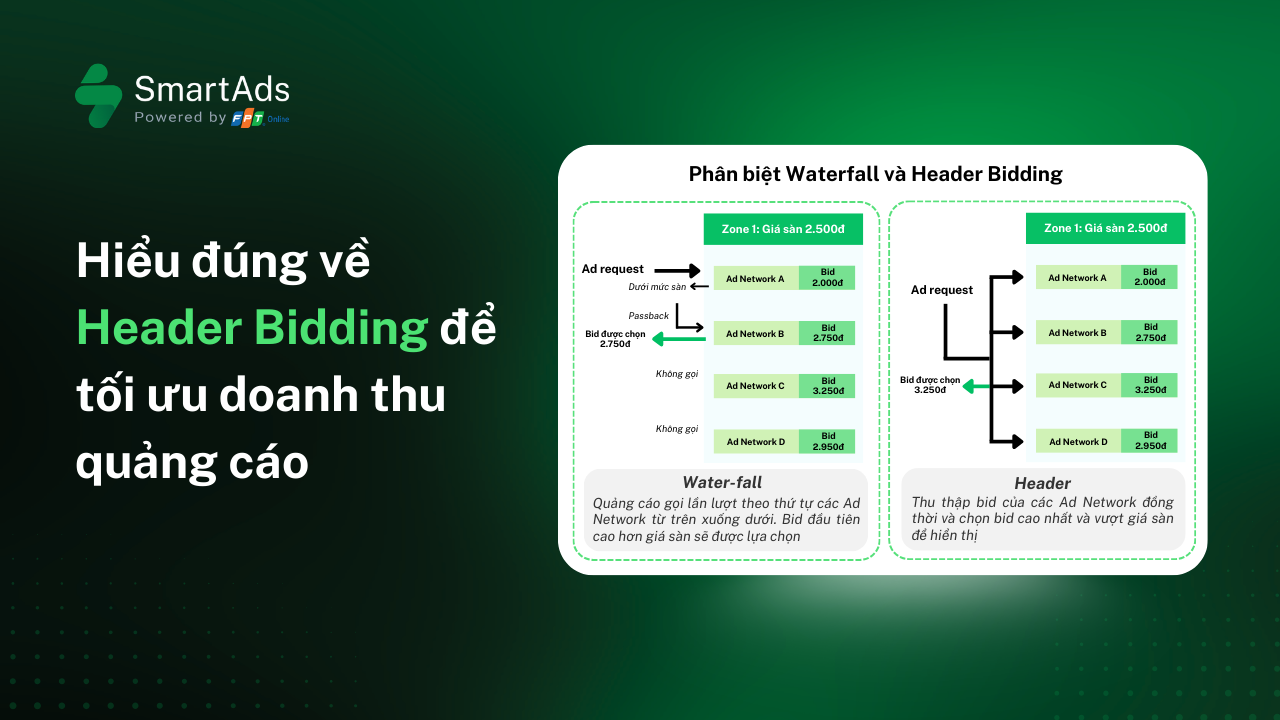
Header bidding: Understanding it to maximize advertising revenue
Header bidding is one of the most transformative innovations in global programmatic advertising, delivering significant revenue growth for publishers and offering greater transparency compared to traditional auction models. So what is header bidding? What are its benefits, challenges, and practical applications in the Vietnamese market? Let’s explore in depth with SmartAds in the article below.
What is header bidding? Comparing it with the waterfall model
Definition and how header bidding works
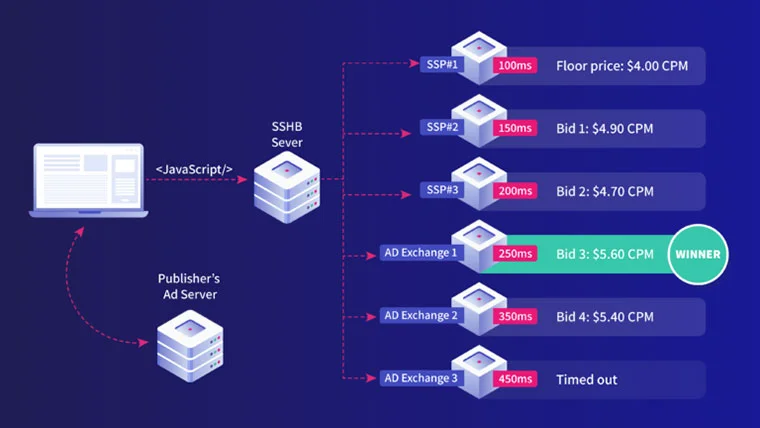
Header bidding is an advanced ad monetization method in which publishers run a simultaneous auction among multiple ad networks and ad exchanges before passing the winning bid to the primary ad server. Advertisers across various demand sources participate in real-time bidding, enabling publishers to secure the highest possible price for each impression.
The header bidding process typically works as follows:
- When a user visits a website, a script embedded in the website’s header is triggered.
- This script simultaneously sends bid requests to multiple ad exchanges and ad networks.
- Demand partners return their bids, the highest bid is selected, and the result is passed to the main ad server to serve the winning ad.
Difference between header bidding and waterfall
The waterfall model is a traditional ad auction mechanism where inventory is offered sequentially based on a predefined priority order (often historical performance). If the first network declines to purchase, the impression is passed to the next network, and the process continues until the inventory is sold. The major drawback is limited competition, often resulting in lower CPMs and under-monetized inventory.
Compared to the waterfall approach (sequential auction), header bidding creates a fair and competitive auction environment, as all demand partners gain access to the inventory simultaneously rather than through tiered priority. All ad networks and ad exchanges bid in parallel. Key advantages include:
- Maximized ad revenue through real-time price competition.
- Reduced inventory waste.
- Higher CTR and improved CPC efficiency by selecting higher-quality and more relevant ads for users.
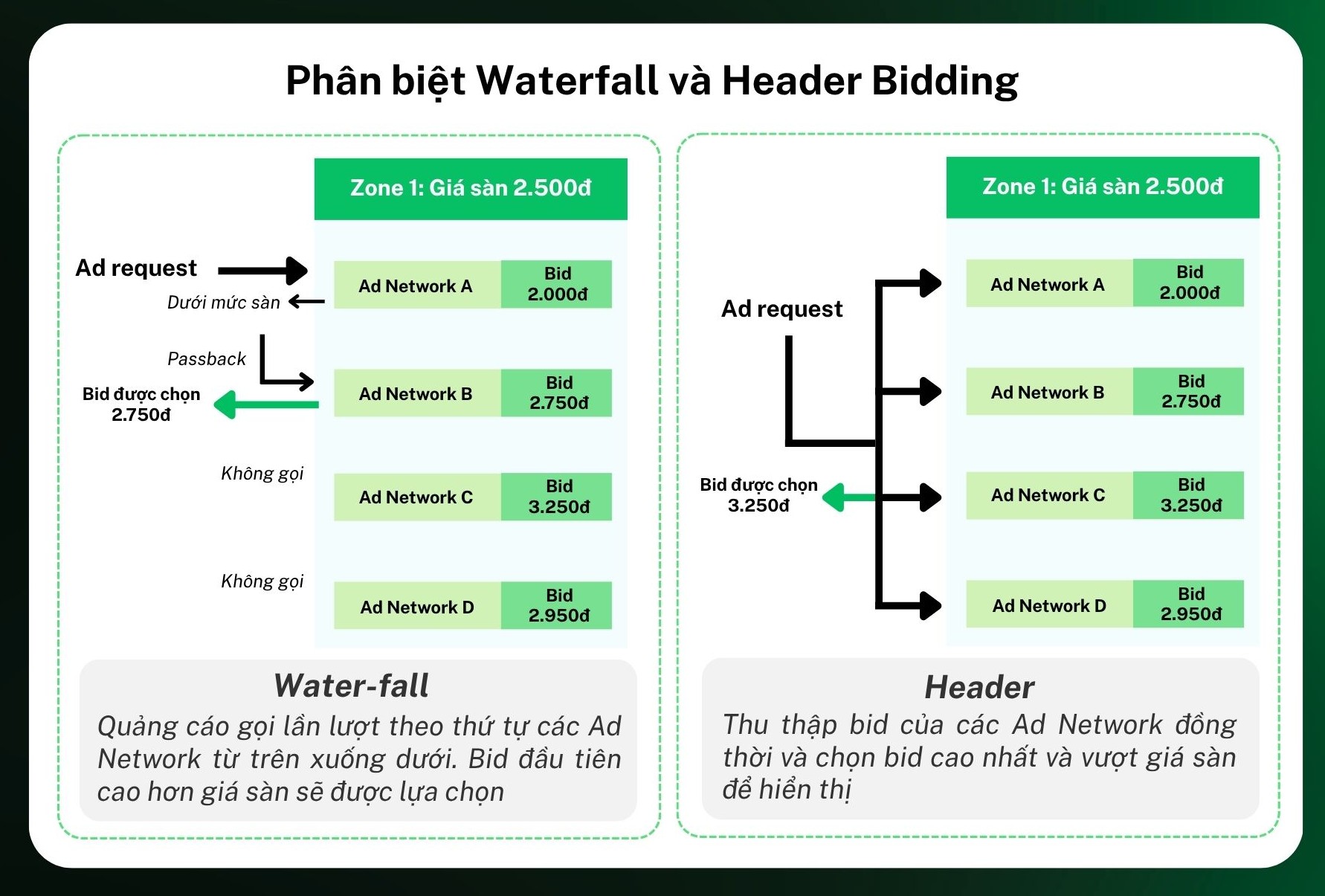
Based on the illustration, the auction mechanisms operate as follows:
a. With the waterfall model:
-
Ad Network A: bids 2,000 VND → below the 2,500 VND floor price, therefore skipped.
-
Ad Network B: bids 2,750 VND → meets the requirement and wins; B’s ad is served.
-
Ad Networks C and D: not called, even though C bid 3,250 VND, which is higher than B’s bid.
This approach is considered less efficient because the fixed priority order prevents publishers from capturing the highest possible bid.
b. With header bidding:
-
Ad Network A: bids 2,000 VND → eliminated for being below the floor price.
-
Ad Networks B and D: not selected.
-
Ad Network C: bids 3,250 VND → highest bid and wins the auction; C’s ad is served.
Overall, header bidding maximizes publisher revenue while ensuring fairness and transparency among ad networks.
Practical benefits of header bidding for businesses
Increase revenue and optimize advertising performance
Publishers implementing header bidding typically report revenue increases of 20–40% compared to the traditional waterfall model. This uplift is driven by direct bid competition across multiple ad exchanges and ad networks.
Beyond revenue growth, header bidding also helps publishers:
- Improve CTR and reduce average CPC for advertisers.
- Enhance ROI by selling inventory at fair market value while reaching the right target audience.
Enhance transparency and control
A major advantage of header bidding is greater transparency in the ad delivery process. Publishers can:
- Monitor each auction in real time.
- Proactively set and adjust floor prices.
- Select high-quality demand sources aligned with brand safety standards.
Real-time data systems enable stakeholders to quickly analyze performance, identify issues, and make data-driven optimization decisions.
Ability to integrate multiple demand sources
Header bidding allows publishers to connect their inventory to multiple ad exchanges, DSPs, and SSPs simultaneously. This maximizes demand access while maintaining better control over ad quality and monetization strategy.
Key considerations and challenges when implementing header bidding
Technical complexity and system management
Implementing header bidding requires strong technical capabilities:
- Proper SDK integration and connections with multiple SSPs/DSPs.
- Latency management to optimize page load speed.
- Continuous monitoring of performance metrics and technical alerts.
Risk management and continuous optimization
Header bidding also presents potential risks such as:
- Advertising fraud (ad fraud).
- Malicious code or ad serving disruptions.
- Algorithm changes that impact auction dynamics.
Therefore, publishers should consider implementing robust brand safety controls, conducting periodic data analysis, monitoring anomalies, and maintaining technical backups to ensure continuous platform updates and operational stability.
Conclusion
Header bidding is no longer just a trend but a strategic choice for publishers and marketers aiming to maximize ad revenue, improve data transparency, and ensure brand safety in the programmatic advertising ecosystem. Partnering with advanced technology solutions like SmartAds can help elevate your advertising performance in today’s programmatic era.