A well-known organic cosmetics brand launched a Tet holiday campaign with a daily budget of VND 10 million. The initial results were highly promising: ROAS reached 4.5, CPA stayed at just VND 120,000, and orders were stable at 80–100 per day. Encouraged by this success, the marketing team decided to “step on the gas” by doubling the budget to VND 20 million per day and expanding the audience to the 35–45 age group.
However, things did not go as smoothly as expected:
-
Day 1: ROAS dropped to 3.2
-
Day 2: CPA spiked to VND 250,000
-
Day 3: Orders fell sharply to just 30–40 per day
The team had to quickly “hit the brakes” and reduce the budget back to its original level—but performance never fully recovered to its initial state.
Do you see yourself in this story?
Increasing your advertising budget without a clear strategy is like driving on a mountain road without controlling your speed—the risk of slipping off the edge is almost inevitable. In this article, SmartAds will break down what scale ads really are, the “golden” signals that tell you it’s time to scale, and practical tips to scale smoothly—just like leading brands do.
I. What are Scale Ads?
Scale ads refer to the process of expanding the budget or reach of an advertising campaign with the goal of increasing audience size, conversions, and revenue—while still maintaining strong performance and a healthy return on investment.
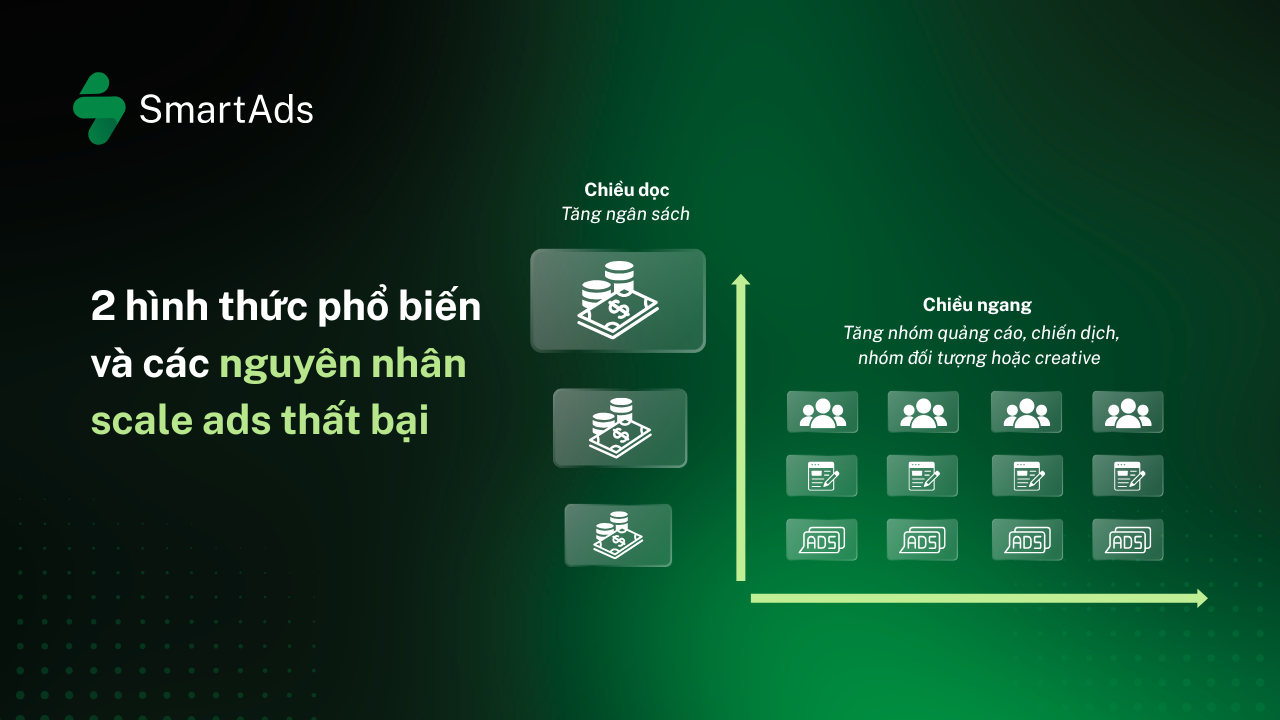
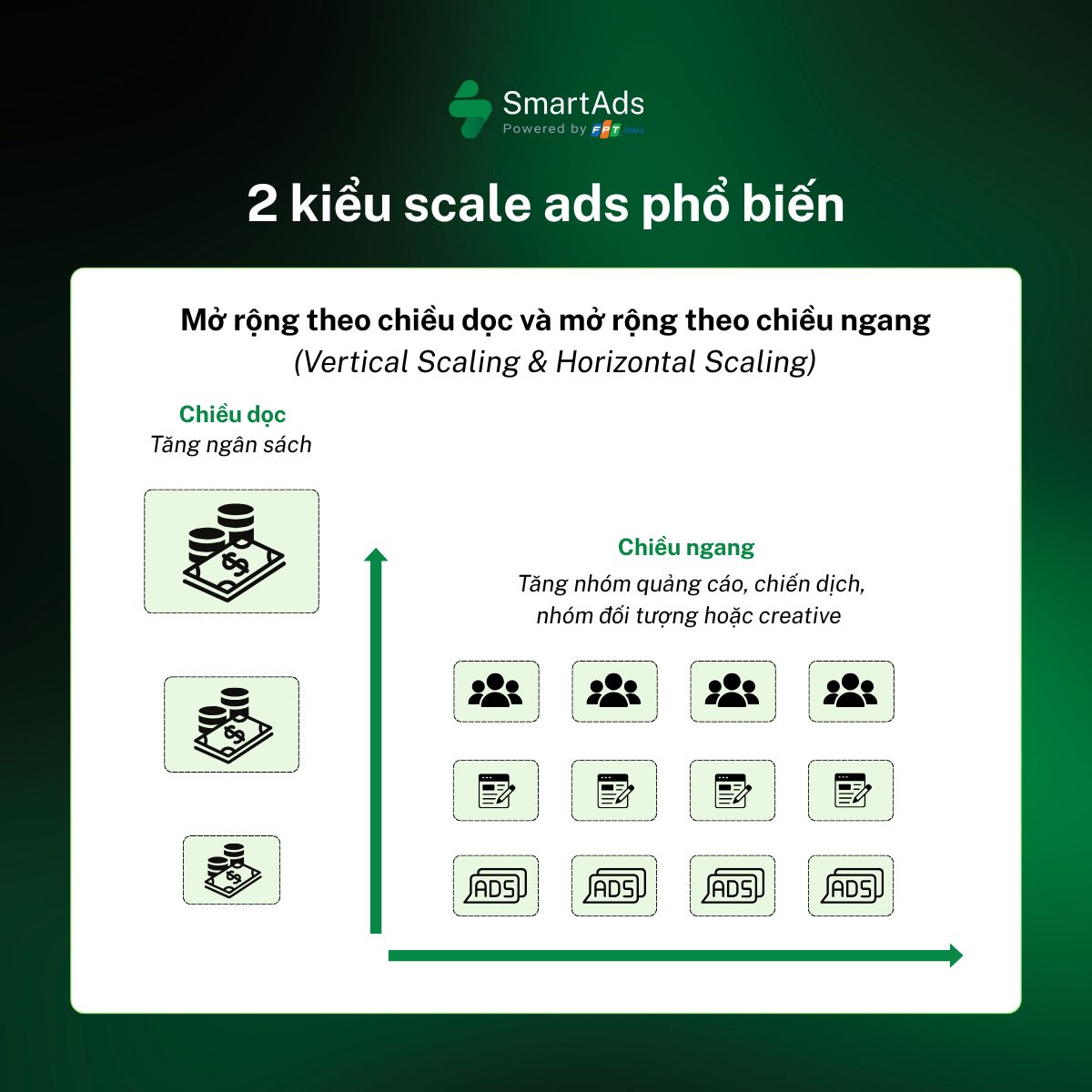
There are two common scaling approaches:
-
Vertical Scaling: Increasing the budget of campaigns that are already performing well.
-
Horizontal Scaling: Expanding by creating additional ad groups or campaigns, or by testing new audiences and creative variations.
II. When is the right time to scale your budget?
Scaling ads should only be done when a campaign has accumulated sufficient data and is showing clear signs of effectiveness. Scaling too early when ads are not yet stable or winning target/creative combinations have not been validated often leads to higher costs without proportional results. Some key indicators that signal the right timing include:
-
The campaign has passed the testing phase: Metrics such as CPA, CTR, and conversion rate remain stable over several consecutive days without major fluctuations. This indicates that the algorithm has learned enough to optimize delivery effectively.
-
ROAS meets or exceeds expectations: ROAS should remain stable or even increase slightly as the budget grows. If ROAS drops sharply after a budget increase, it’s a sign that adjustments are needed before scaling further.
-
Ad frequency remains low: Ensuring your ads are not shown too repeatedly and that the target audience has not yet reached saturation.
-
No signs of “audience fatigue”: The audience continues to respond positively, without declining CTR, engagement, or sudden cost spikes.
III. How to Scale Ads effectively
1. Adjusting the budget
This is a form of Vertical Scaling expanding ad spend by increasing the budget of ad sets or campaigns that are already delivering strong results. When applying this approach, keep the following in mind:
-
Increase the budget directly at the ad set or campaign level.
-
Increase gradually by only 10–30% each time to avoid sudden changes that can reset the learning phase and destabilize CPA and ROAS.
-
Closely monitor CPA and ROAS after each increase to make timely budget adjustments.
2. Ad set duplication
This is a Horizontal Scaling method that expands reach by duplicating high-performing ad sets into new ones to increase coverage. You can apply one of the following approaches:
-
Duplicate a high-performing ad set: This allows you to maximize what’s already working without changing the original campaign structure.
-
Keep settings the same or make minor tweaks: Slight adjustments to budget, targeting, or creative can help test scalability without significantly disrupting the learning phase of the original ad set.
3. Expanding the Audience pool
This Horizontal Scaling approach focuses on expanding reach by targeting new audience segments with similar interests but different demographics, or users with behaviors similar to existing high-converting customers. Specifically:
-
Geographic expansion: Tap into less saturated markets. For example, cosmetics brands can test nearby regions or provinces with strong online shopping behavior if logistics allow.
-
Interest expansion: Broaden interest targeting to related or indirectly relevant interests to uncover new high-potential segments.
-
Leveraging Lookalike Audiences: Expand by targeting users similar to existing buyers or high-value actions, helping scale while maintaining stable conversion rates.
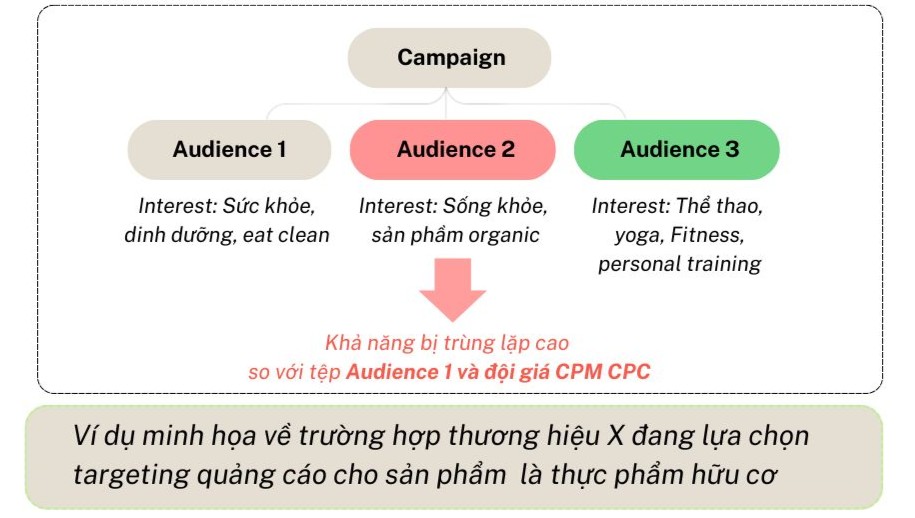
A common mistake when scaling ads this way is splitting the budget across too many ad sets that target similar or nearly identical audiences. This can lead to ad overlap, internal auction competition, higher CPM/CPC, and ultimately higher CPA.
To avoid this, segment audiences at a reasonable scale, prioritize clearly differentiated interests or behaviors, and regularly conduct A/B testing to identify and pause underperforming or overlapping groups.
4. Optimizing ad creatives
Creative optimization is a core factor in capturing attention and driving action. When scaling, creatives must not only reach a wider audience but also remain compelling enough to generate real conversions.
-
Number of creatives per ad set: Use 3–5 different creative variations (images, videos, designs) to maintain freshness and support algorithm optimization.
-
Optimize for different placements: Ensure formats and layouts fit each placement to avoid cropping, distortion, or message loss.
-
A/B test creatives to find top performers: Identify which visuals and messages deliver the highest engagement and conversion rates, then allocate more budget to winning creatives.
5. Understanding bidding fundamentals
Most advertising platforms operate on an auction-based system, where ads compete based on bid, ad quality, and estimated action rate. Increasing budget alone does not guarantee better results if bids and creative quality are not properly managed.
-
Closely monitor CPA, CPM, and ROAS after each budget increase.
-
Prioritize high-performing ads with strong CTR and engagement, as platforms favor quality ads with lower auction costs.
-
Consider bid caps or cost caps when scaling aggressively, while testing carefully to avoid limiting delivery.
6. Maintaining optimal frequency
Ad frequency plays a supporting role in scaling success, ensuring ads do not become repetitive or cause fatigue.
-
Low frequency (<1 time/week): Plenty of room to scale safely.
-
Moderate frequency (1–3 times/week): Scaling is possible but requires close monitoring.
-
High frequency (>3 times/week): Avoid further budget increases; refresh creatives or messaging instead.
7. Additional considerations
-
Don’t scale without enough data: Wait until the campaign achieves a minimum volume of conversions (e.g., 50 events within 7 days).
-
Avoid changing too many variables at once: Adjust only 1–2 factors at a time to clearly measure impact.
-
Reassess strategy if ROAS drops sharply despite higher budgets, as this may indicate market saturation or weak messaging.
Conclusion
Scale ads is an art that requires a careful balance of data, strategy, and adaptability. Increasing budget does not automatically mean higher performance unless the foundation creative quality, audience segmentation, bid control, and frequency management is strong enough.
With SmartAds, ads are distributed based on user reading behavior, enabling seamless A/B testing, transparent reporting, and timely optimization decisions helping businesses scale ads confidently without sacrificing performance.