1. How to identify ads that aren't spending?
Running ads aims to increase user reach. However, in some cases, after reactivating an ad, it may enter a “stalled” state—showing no impressions, no reach, no clicks, and generating no spend. This is known as a “no spend” or “slow spend” situation, which can significantly affect campaign performance. Here are three common indicators to detect this issue early:
-
After 24 hours: The ad has been approved but hasn't generated any spend; metrics like Impressions, Reach, and Clicks remain at 0, indicating a high likelihood of a technical error or misconfiguration.
-
After 48 hours: By the second day, the distribution system usually begins optimizing based on collected data. If the ad still isn’t spending or spending very little, review the content quality, audience targeting, or optimization goals.
-
After 72 hours: Three days is generally considered the maximum period for ad performance stabilization. If CPM, Reach, or Clicks remain at 0 or the budget is spent very slowly, the campaign likely has technical issues preventing effective distribution.
2. Technical and setup reasons that hinder ad distribution
2.1. Budget and Bidding
-
Insufficient budget: If the daily or total campaign budget is too low relative to the audience size and market competition, the system may restrict ad distribution.
-
Low bid amount: Using manual bidding with amounts significantly below the market average makes it difficult for the ad to compete against higher-bidding competitors.
2.2. Audience and Scale
-
Audience too narrow: Applying excessive targeting filters (location, age, interests, behaviors, etc.) with a very limited reach can make it challenging for the system to optimize ad distribution.
-
Audience overlap: Running multiple A/B tests targeting the same audience groups may result in internal competition among ad sets, lowering overall performance.
2.3. Tracking Behaviors and Events
Lack of conversion data or behavioral signals: Some platforms support CPA-based ad buying by optimizing for specific user actions. If a campaign is optimized for a particular behavior but the system receives insufficient signals (clicks, content views, add-to-cart), ad optimization slows, resulting in low distribution. Common causes include:
-
Pixel/SDK/event tracking not installed or misconfigured, preventing the system from capturing user behavior.
-
Conversion event not activated correctly (e.g., only tracking page views but optimizing for add-to-cart or purchase).
-
Lack of synchronization between ad platform and website/app (unverified domain, missing data-sharing permissions).
-
Cookies restricted or blocked by browsers, iOS ATT, or ad-blockers, resulting in signal loss.
-
Budget too low or campaign duration too short, or target audience too narrow, leading to insufficient impressions for machine learning algorithms.
-
Low occurrence of target behaviors, especially for high-priced products or long decision cycles (e.g., real estate, cars, luxury jewelry).
-
No intermediate steps to “nurture” data such as optimizing for view content, clicks, combined with first-party data (CRM, previous customer data) to support CPA optimization.
-
Continuous campaign structure changes, resetting the machine learning phase.
3. Reputation-Related factors affecting ad review
3.1. Account Quality
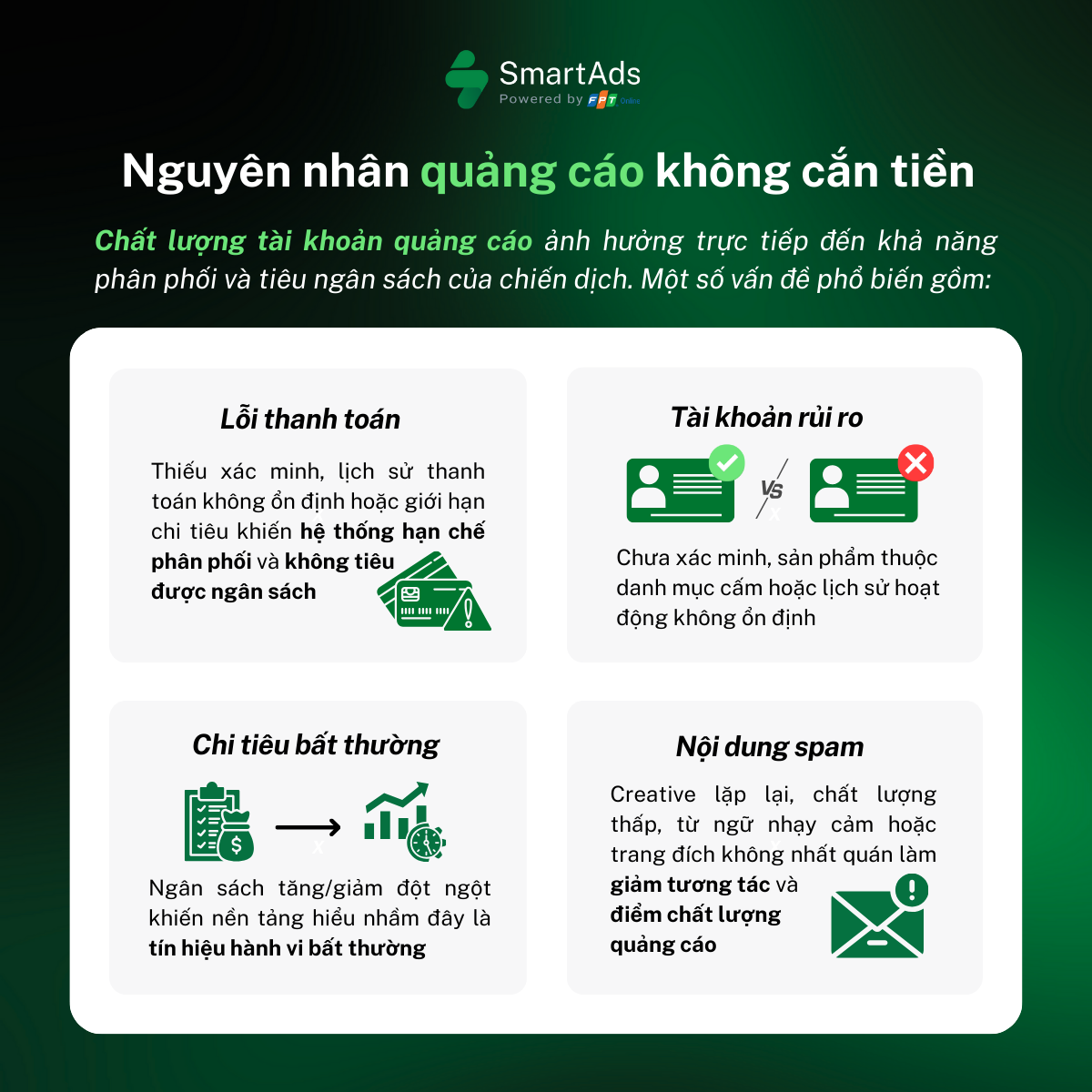
Ad account quality directly influences campaign distribution and budget spend. Common issues include:
-
Untrusted account: Some platforms review ad accounts before approving distribution. New accounts or accounts with repeated content policy violations may have reduced trust scores, limiting ad delivery.
-
Missing verification information (identity, payment, legal), resulting in budget limits and no spend.
-
Low trust score or random review triggers, causing weak distribution or paused ads even after activation.
-
Payment limits or insufficient account credibility: Platforms may evaluate payment history or spend capacity. New accounts or unstable payment history, including poor credit card history, may experience restricted distribution.
-
Even accounts with good trust and credit history can experience delays if time zone settings are incorrect, affecting approval and spend.
3.2. Ad Creative
-
Poor ad quality: Blurry or irrelevant visuals, or content that is uncomfortable or misleading, can lower engagement and limit ad distribution.
-
Use of sensitive or absolute terms: Words like “guaranteed,” “best,” “most trusted,” or “high profit” may prevent ad approval.
-
Promoting restricted or prohibited products: Items such as alcohol, tobacco, or controlled stimulants face strict regulations, leading to ad rejection, long review times, or limited distribution.
-
Lack of creative updates causing Ad Fatigue: Users familiar with an ad may find it boring, reducing engagement.
-
Landing page quality issues: Clicking an ad and landing on irrelevant content disrupts user experience, lowers trust, increases bounce rates, reduces conversions, and negatively impacts ad distribution.
4. Solutions to fix “No Spend” issues and optimize ad distribution
To ensure ad campaigns are distributed efficiently, optimized for cost, and effectively reach target customers, here are some key tips for advertisers:
-
Automatic optimization: Most modern ad platforms provide automated cost and distribution optimization based on user behavior data. Utilizing these features reduces the risk of low bids or insufficient budgets, quickly captures customer behavior signals, ensures precise distribution, and optimizes conversions according to campaign goals (engagement, clicks, conversions).
-
Smart audience segmentation and expansion: Segment audiences into clear groups, avoid overlaps, and expand potential customer reach using behavior data.
-
Budget optimization: Use fixed budgets or automatic allocation across ad sets to optimize spend. Monitor daily spend and adjust based on performance to prevent misallocation to underperforming ads.
-
Enhance ad quality: Regularly refresh ad content to reduce Ad Fatigue by optimizing images, videos, headlines, descriptions, and CTAs to fit the audience. Control ad frequency to avoid wasted budget and negative user experience.
Overall, besides proper campaign setup, choosing the right advertising platform aligned with user behavior affects distribution. A stable, transparent system helps advertisers avoid “no spend” situations due to uncontrollable errors. With SmartAds, accounts enjoy high stability, simple payment operations, and uninterrupted campaign execution. Especially when ads are restricted due to policy violations, the platform provides clear notifications or suggested fixes to help advertisers make adjustments.
If you are looking for a reliable advertising solution with a stable environment ensuring brand trust, don’t hesitate to create an account and experience campaign setup on SmartAds here.