NLP definition
What is NLP? NLP (Natural Language Processing) is a field of Artificial Intelligence that focuses on researching and developing technologies enabling computers to understand, process, and generate human language in a natural way. Unlike traditional text processing approaches that mainly operate at the character or keyword level, NLP emphasizes contextual understanding, semantic meaning, and even the emotional intent behind words and texts.
With the rapid advancement of Machine Learning and Large Language Models (LLMs) such as BERT and ChatGPT, NLP has significantly expanded in both application scope and accuracy. Today, NLP is no longer limited to English processing but has extended to multiple languages, including Vietnamese, enabling businesses to engage with customers faster and more effectively across markets.
Core components of NLP
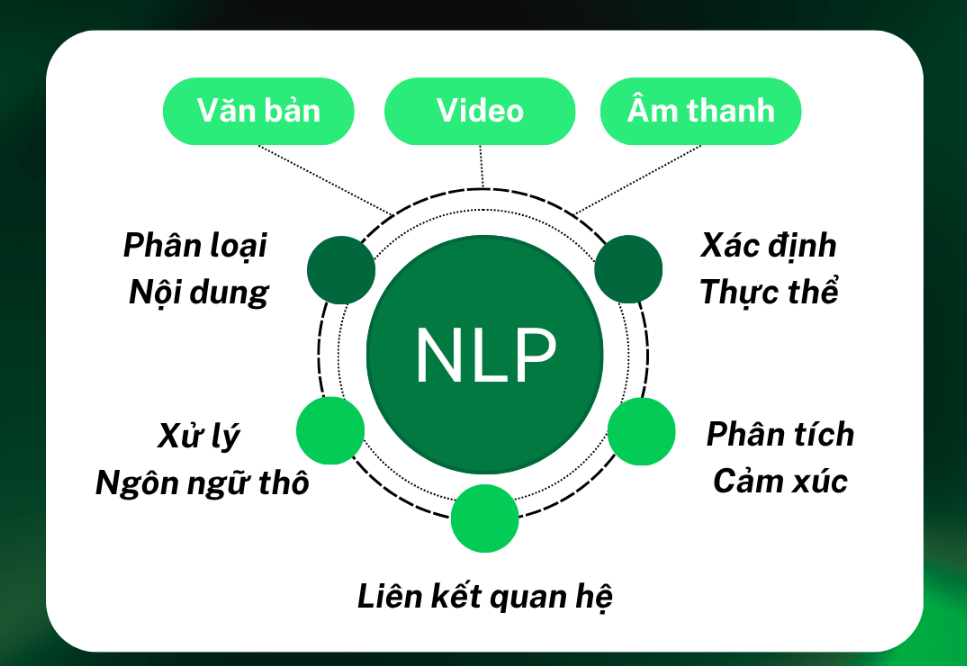
Text, video, and audio data are fed into NLP systems and processed through several core operations, including:
- Parsing (Syntactic parsing): Identifying sentence structures and grammatical relationships between words.
- Semantic analysis: Evaluating the true meaning and intent behind textual content.
- NER (Named Entity Recognition): Detecting specific entities such as people, locations, organizations, and brands within text.
- Text summarization: Condensing long documents into concise versions while preserving key information.
- Text generation: Automatically producing sentences, paragraphs, or complete articles.
- Machine translation: Translating content between different languages.
- Classification: Labeling and categorizing content based on predefined topics or intent.
- Sentiment analysis: Identifying emotional tone (positive, negative, or neutral) within content.
Classification of NLP tasks
Modern NLP typically focuses on three main task categories:
- Natural Language Understanding (NLU): For example, analyzing customer feedback or extracting key data from emails.
- Natural Language Generation (NLG): For example, automated chat responses or generating advertising messages.
- Human–machine language interaction: For example, virtual assistants for scheduling, intelligent search systems, or voice-controlled smart speakers.
Each task group can be seamlessly integrated into enterprise marketing systems, customer support platforms, and data analytics workflows.
Practical benefits of NLP for businesses and marketing
Process Automation
Applying NLP within organizations helps automate repetitive tasks such as:
- Classifying and routing customer emails.
- Extracting critical information from documents and contracts.
- Enabling intelligent document search across large data repositories.
Automating Enterprise Workflows with NLP
In Vietnam, many CRM and email marketing platforms have integrated NLP to filter content, categorize customer requests, and reduce operational time and costs. According to the IBM Global AI Adoption Index 2024, over 35% of enterprises in the Asia-Pacific region are already using NLP to automate service operations.
Enhancing User Experience in Marketing
NLP unlocks new possibilities for delivering superior customer experiences:
-
24/7 chatbots and virtual assistants that provide instant customer support.
-
Personalized advertising messages based on text analysis and individual preferences.
-
Improved customer satisfaction metrics such as CSAT and NPS.
Big Data Analysis & Decision Support
Unstructured text from social media, emails, and customer feedback remains an underutilized “gold mine.” NLP enables businesses to:
- Analyze millions of comments and news articles to detect trends and predict communication risks.
- Evaluate marketing campaign performance based on real customer sentiment.
- Measure overall brand health, empowering marketers to make faster and more accurate decisions.
Key applications of NLP
Customer Support & Chatbots
Many large enterprises have deployed AI chatbots powered by NLP to handle tens of thousands of daily requests via chat and email. Compared to manual customer support, these solutions help:
- Reduce customer service staffing costs by over 40%.
- Deliver instant responses without time or channel limitations.
- Automate answers to common queries while routing complex cases to appropriate agents.
AI chatbot applications powered by NLP in customer support
Marketing & Sales
In marketing, NLP plays a critical role across multiple stages:
-
Sentiment analysis on social media (social listening) to refine messaging and align with market psychology.
-
Personalizing shopping experiences through tailored content and product recommendations.
-
Automating content creation for advertising and email marketing campaigns.
Research & Development, Healthcare, and Education
NLP continues to transform how organizations analyze and leverage data:
-
Summarizing reports and analyzing scientific documents to support R&D.
-
Analyzing electronic medical records to assist doctors in early disease detection.
-
Personalizing learning content and evaluating individual student progress.