
What is a pain point?
Simply put, a pain point refers to the real challenges, inconveniences, or concerns that customers experience when using a product or service. These are the weaknesses, negative emotions, or urgent problems customers want to eliminate clearly different from “needs,” which typically describe what customers would like to have, rather than what is actively causing friction.
For example, while a need may be the desire for greater convenience, a pain point arises when customers feel overwhelmed or exhausted by a complicated purchasing process. For marketers, identifying and addressing pain points is critical to crafting highly relevant marketing messages that resonate emotionally and capture attention within the first few seconds of engagement.
Common types of customer pain points
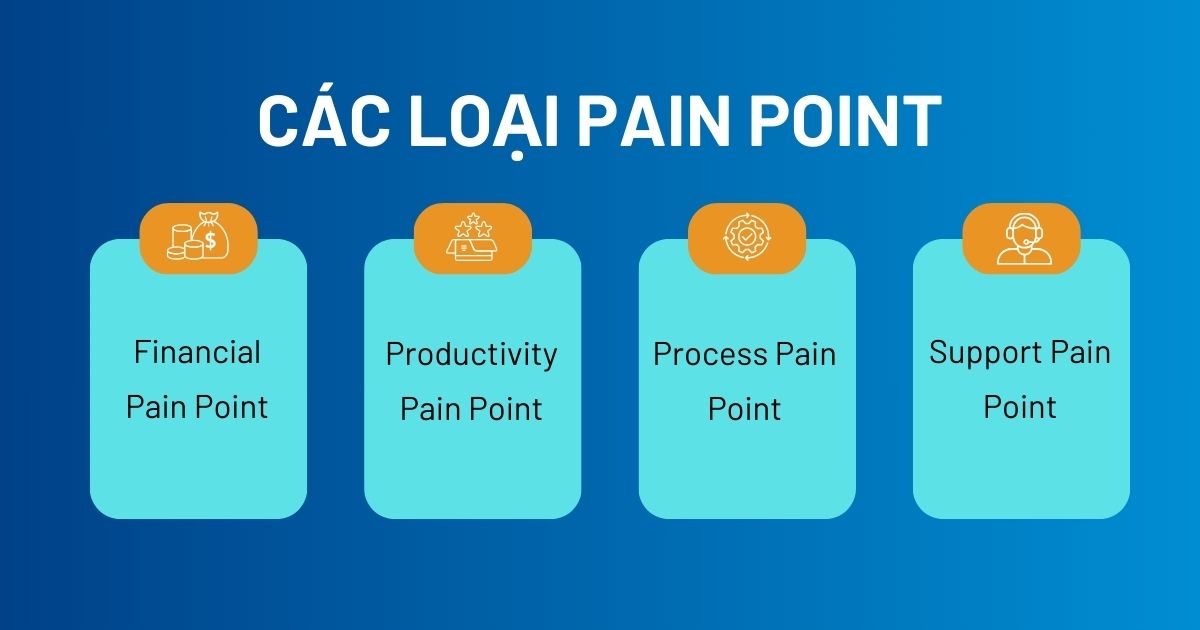
Understanding pain points also known as customer pain areas is the first and most crucial step in building an effective marketing strategy. Every customer has unmet needs and ongoing frustrations, and these pain points are the key to emotional connection and persuasion. Below are the four most common types of pain points that businesses should closely observe and resolve:
- Financial Pain Points: Customers feel that current products or services are too expensive or not cost-efficient. They seek more affordable solutions with clearer ROI or better alignment with their available budget.
- Productivity Pain Points: Customers waste time, effort, or resources due to inefficient workflows. They look for solutions that help them work faster, automate tasks, and improve overall productivity.
- Process Pain Points: Issues arise from complex systems, fragmented workflows, or poor cross-team coordination, leading to confusion and errors. Customers need simpler, clearer, and more streamlined processes.
- Support Pain Points: Customers struggle to receive timely technical support, warranty service, or post-purchase assistance. Feeling unheard or neglected, they expect faster, more responsive, and more human customer support experiences.
Why is identifying customer pain points so important?
Accurately identifying customer pain points is a strategic foundation for improving operational efficiency, enhancing customer experience, and building sustainable competitive advantage. Below are the key reasons why pain point analysis is not only necessary but essential for long-term growth:
1. Enhance Customer Experience
When businesses clearly understand the challenges customers face, they can design targeted solutions that effectively resolve those issues. This reduces frustration, increases satisfaction, and fosters long-term customer loyalty. A seamless customer journey always begins with genuine empathy for customer pain.
2. Build Sustainable Competitive Advantage
In markets where products and services often look similar, the ability to solve customer problems more effectively than competitors becomes the deciding factor. Identifying the right pain points allows brands to differentiate themselves and earn stronger trust from customers.
3. Optimize Products, Services, and Processes
Pain points are not just warning signals—they are directional insights for improvement. Businesses can use customer insights to refine existing offerings or develop new solutions that better align with real market needs.
4. Strengthen Customer Relationships
When customers feel heard and understood, they are more likely to trust and stay connected with the brand. This leads to stronger long-term relationships, higher customer lifetime value (CLV), and more sustainable business growth.
5. Proactively Reduce Risk
Early detection and resolution of pain points help businesses avoid serious issues such as complaint surges, negative social media feedback, or customer churn to competitors.
6. Unlock Innovation Opportunities
Every pain point represents an opportunity for innovation. When businesses treat pain points as opportunities rather than obstacles, they can uncover new product ideas, optimize business models, or even tap into underserved market segments.
Campaigns that focus solely on features often struggle to stand out. In contrast, messaging that directly addresses customer pain points captures attention more effectively and drives higher conversion rates.
How to identify customer pain points effectively
Beyond passive listening, modern marketers must adopt data-driven and practical approaches to proactively uncover customer pain points. Key methods include:
- Analyzing CRM, website analytics, search data, and social listening insights to identify real customer challenges.
- Conducting in-depth interviews and review mining by asking open-ended questions and examining authentic customer feedback.
- Tracking real user behavior across digital platforms, including purchasing journeys and product interactions.
- Experiencing the product firsthand through customer journey mapping to gain a holistic perspective.
- Collecting customer feedback data via online surveys, comments, and call logs.
- Listening to and categorizing pain points by function, emotion, cost, or experience.
- Validating findings with representative customer groups and prioritizing pain points with the highest impact on conversion.
Accurately positioning customer pain points enables brands to deeply understand real challenges while unlocking truly effective marketing strategies. Modern marketers must embrace data-driven methodologies, actionable customer insights, and a customer-centric mindset not just to communicate correctly, but to solve the right problems and drive long-term business growth.