1. The Pepsi challenge - Challenging a market giant
In the 1930s, Pepsi was still positioned as a low-priced and relatively unknown product compared to its rival. However, from the very beginning, the brand demonstrated a bold and disruptive approach to advertising. At that time, Pepsi launched the “The Pepsi-Cola Challenge” campaign, directly comparing its taste with Coca-Cola. The campaign quickly gained traction and helped Pepsi capture additional market share.
By the late 1970s, after strengthening its position through the merger with Frito-Lay, Pepsi returned to its original inspiration with the “Pepsi Challenge.” This campaign featured a blind taste test, where consumers participated in surveys by sampling two unbranded cups—without knowing whether they were drinking Pepsi or Coca-Cola. The results were unexpected: a majority of Americans chose Pepsi, positioning the brand as an equal competitor to its long-standing rival.
2. Outdoor advertising in madrid: A creative message of holiday greetings
Madrid has long been regarded as one of the global “capitals” of out-of-home (OOH) advertising. With its massive billboard network, the city has become a go-to destination for brands seeking strong visual impact and increased brand visibility. The appeal of OOH in Madrid lies not only in its scale or strategic locations, but also in its bold, creative messaging that dares to stand out. This very factor has enabled many campaigns to go viral and even become headlines in mainstream media.
Christmas 2019 provided a notable example. Coca-Cola chose OOH advertising to send a message of unity to Pepsi. As expected, Pepsi did not miss the opportunity to respond. The brand quickly delivered a witty and sophisticated counter-message, turning its competitor’s greeting into a reverse communication advantage.
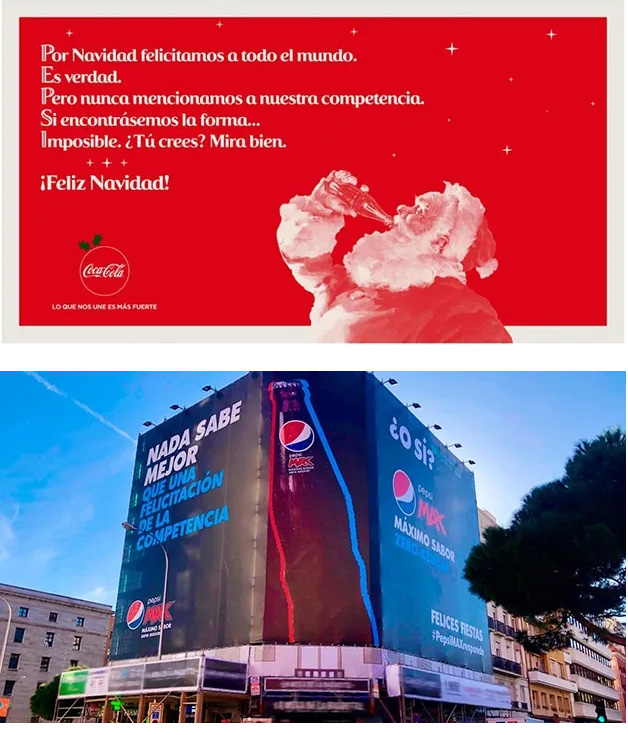
In this campaign, Coca-Cola stayed true to its brand spirit closely associated with Christmas: warmth and togetherness. The core message stated, “We wish everyone a Merry Christmas, including our competitors.” Instead of explicitly naming its rival, Coca-Cola subtly acknowledged the competition through an implicit and symbolic message. This approach allowed the brand to maintain a calm, elegant image—reinforcing its leadership position without direct comparison. It was a smart strategy to strengthen brand affinity and further associate Coca-Cola with positivity and unity during the festive season.
Unlike Coca-Cola, Pepsi adopted a more direct counterattack, turning its rival’s Christmas greeting into an opportunity. With the message “Nothing beats a wish from a competitor,” Pepsi both acknowledged Coca-Cola’s status and cleverly flipped the narrative to generate media buzz. This youthful and provocative approach reinforced Pepsi’s challenger brand image, placing it at the center of public discussion and driving strong viral engagement.
3. When a “Prank” becomes a communication opportunity
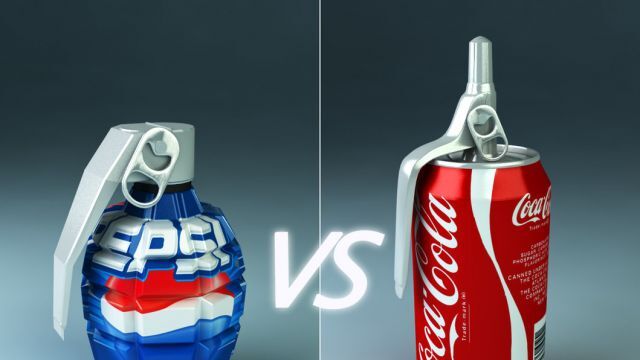
Halloween 2013 marked one of the most memorable face-offs between Pepsi and Coca-Cola. During this occasion, Pepsi proactively launched an advertising campaign featuring a Pepsi can dressed in Coca-Cola’s iconic red cape, accompanied by the message “We wish you a scary Halloween.” The short tagline and striking visual required no explanation, clearly conveying an attempt to mock its competitor.
However, rather than reacting defensively, Coca-Cola quickly turned the situation to its advantage. By keeping the visual intact and simply changing the tagline to “Everyone wants to be a hero,” the market leader successfully reframed the message in a positive direction and regained control of the brand narrative.
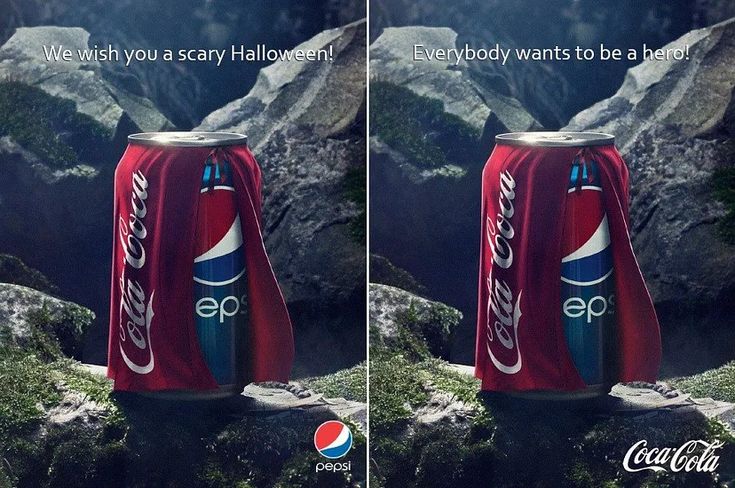
What stands out is that this response not only neutralized the attack, but also demonstrated Coca-Cola’s composure and brand confidence in an intense competition. Instead of escalating the conflict, Coca-Cola turned the challenge into an opportunity to reinforce its “hero” positioning—strengthening brand equity while amplifying earned media reach.
Key communication lessons from the “Cola Wars”
Across a series of iconic campaigns in the long-standing competition between Coca-Cola and Pepsi—from the Pepsi Challenge of the 1930s, the OOH exchanges in Madrid in 2019, the subtle response during Halloween 2013, to large-scale activations such as Super Bowl 2019—five core lessons emerge for modern brand management:
- Speed defines positioning: Brands that respond quickly and intelligently gain control of the narrative. Coca-Cola’s Halloween case is a clear example.
- Direct comparison requires creativity: Comparative advertising can deliver strong impact, but only when executed with clarity, creativity, and entertainment value—as demonstrated by the Pepsi Challenge.
- Turn challenges into opportunities: Competitive attacks can become valuable moments for repositioning or increasing brand favorability, as Coca-Cola successfully demonstrated.
- Organic reach through earned media: Successful campaigns extend beyond paid media, spreading organically across press and social platforms to optimize costs.
- Align brand building with business performance: Long-term brand investment creates sustainable value, but without short-term performance impact, brands risk losing momentum. Both Pepsi and Coca-Cola continue to integrate these elements as they expand product portfolios and sustain ongoing marketing campaigns.
Investing in brand identity and developing a distinct brand personality is essential to stand out in a competitive market. However, this alone is not enough. To maximize effectiveness, businesses must combine branding (long-term brand equity) with performance (conversion optimization).
Currently, SmartAds is delivering a Brandformance (Branding x Performance) solution—a marketing model that directly connects advertisers with premium publishers. This approach enables brands to ensure high-quality brand presence while reaching the right audiences at optimized costs, ultimately driving higher conversion rates and measurable business results.