
What is ROI in marketing? Meaning and basic ROI calculation
ROI (Return on Investment) is one of the most important financial metrics in modern business management and marketing. This indicator measures the profitability of an investment by comparing the net profit generated with the total cost invested. ROI is typically expressed as a percentage and is widely used to evaluate the effectiveness of projects, marketing campaigns, or even an entire business operation.
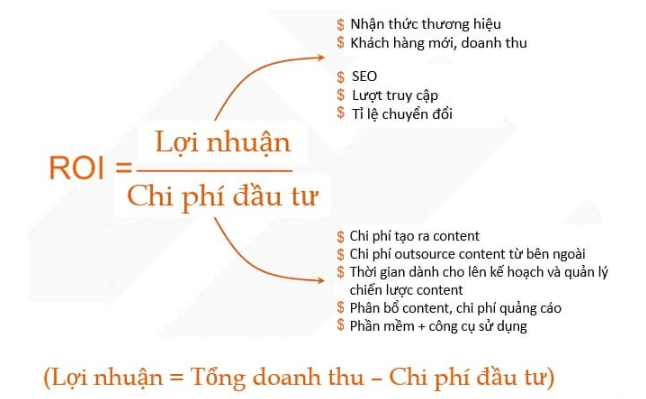
The ROI formula is simple: ROI = (Net Profit / Investment Cost) x 100%
Example: if a business spends 100 million VND promoting a newly launched product and generates revenue of 150 million VND.
Then: Net Profit = Revenue – Cost
=> ROI = (150 – 100) / 100 x 100% = 50%.
This means that for every 1 VND invested, the company earns an additional 0.5 VND in profit.
How to determine net profit and investment cost to calculate ROI
To calculate ROI accurately, businesses need to:
-
Determine net profit: This is the amount remaining after deducting all related costs (production, marketing, operations, human resources, etc.).
-
Determine investment cost: This includes the total capital initially spent on the project, campaign, or business activity.
Beyond the basic formula, marketing also uses several ROI variations:
-
Advertising ROI (Ad ROI): Measures the effectiveness of advertising campaigns on platforms such as Google Ads, Facebook Ads, and TikTok Ads.
-
Content ROI: Evaluates the impact of SEO strategies, blogs, and video marketing initiatives.
-
Brand ROI: More difficult to quantify but useful for measuring brand value and customer loyalty after communication campaigns.
Why ROI is important in business and marketing
- Evaluate investment performance: ROI clearly indicates whether an investment generates profit, helping businesses decide whether to continue or stop a project.
-
Compare different investments: When facing multiple opportunities, companies can rely on ROI to select the most profitable option and ensure efficient capital allocation.
-
Support business decisions: ROI data provides an objective basis for budget allocation, marketing strategy adjustments, sales performance optimization, and risk management.
-
Attract investors: A company with strong ROI demonstrates profitability potential, which can attract investors to contribute capital or acquire shares.
One important note is that a “good” ROI does not have a fixed benchmark and depends on business objectives, industry characteristics, and operational context. When calculating marketing ROI, it is also necessary to exclude organic or natural growth to accurately measure the value generated by a specific campaign.
Benefits and strategic value of optimizing ROI in marketing
Measuring ROI is not only essential for marketing practitioners but also serves as a strategic decision-making tool for marketing directors and business owners.
Evaluate the performance of marketing strategies and channels
- Identify strengths and weaknesses among different advertising channels or campaigns
- Allocate budgets more effectively by focusing resources on solutions that deliver higher ROI
Enable flexible decisions and strengthen competitive advantage
By closely monitoring campaign performance through ROI, businesses can make flexible adjustments and optimize results whenever campaigns fail to meet expectations. This not only helps reduce costs and improve profit margins but also creates a competitive advantage over industry rivals. Therefore, understanding different ROI levels allows companies to assess investment performance accurately and make informed decisions:
-
High ROI: Indicates a highly effective and profitable investment.
-
Low ROI: Signals inefficiency or potential waste of resources.
-
Negative ROI: Shows that the investment is generating losses and requires strategic review or cost reduction.
The relationship between ROI and marginal ROI
Marginal ROI measures the profit generated from each additional unit of spending (for example, increasing marketing budget or adding a new tactic). This approach helps determine the optimal point where additional investment still generates acceptable profit and where it no longer does. This concept is important because overall ROI may hide the effectiveness of incremental spending. While overall ROI may decrease as budgets increase, marginal ROI analysis may reveal that additional small investments still deliver positive returns and help maximize total profit.
Formula:
-
Marginal ROI = (Incremental Profit / Incremental Cost) x 100%.
-
Here, “incremental profit” refers to additional profit generated from the increased investment, while “incremental cost” refers to the extra spending required for that investment.
Many marketing decisions are based on adjusting or adding elements to existing campaigns, programs, or marketing mixes—such as introducing a new tactic into an integrated campaign or adding a promotional offer to an ongoing initiative. Incremental ROI evaluates only the added change, separating it from the original baseline decision. By analyzing marginal ROI for each incremental investment, businesses can identify which additional spending delivers the highest impact and allocate resources more effectively. This supports better decision-making when expanding production, launching new marketing campaigns, or investing in profitable opportunities.
When incorporating the concepts of incremental investment or marginal spend, it is important to remember that the objective is to maximize profit, not simply maximize ROI. Better decisions can be made when measurement shows that small incremental investments still deliver strong returns—a reality that might be overlooked if only overall ROI is considered. Figures 3 and 4 below illustrate this concept.
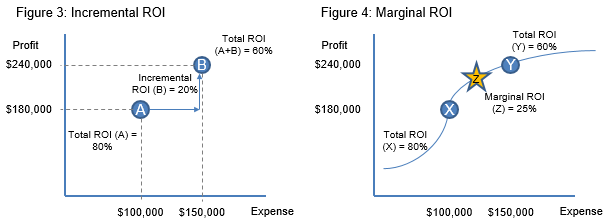
In the example shown in Figure 3, adding marketing element B (for example, a second contact) to marketing initiative A (the initial contact) increases profit but reduces overall ROI from 80% to 60%. Incremental ROI shows that $50,000 of additional spending generates $70,000 in profit, equivalent to a 20% ROI. If the company sets a minimum ROI threshold of 25%, adding the second contact would not meet the requirement. However, in other scenarios where incremental ROI exceeds the threshold, a decrease in overall ROI may still be acceptable. In Figure 4, marginal ROI helps determine the optimal diminishing returns point between X and Y—where ROI still meets the required threshold. Once spending increases further, the threshold is no longer achieved. Identifying this point often requires advanced analytical models.
Advantages and limitations of using ROI
Advantages:
-
Easy to calculate with a simple formula.
-
Highly comparable, providing a basis for selecting among multiple projects.
-
Widely applicable in business, marketing, and finance.
Limitations:
-
ROI does not reflect the time factor (for example, 30% ROI in one month differs significantly from 30% ROI in one year).
-
It does not account for market risks, cost fluctuations, or long-term strategic factors.
-
It may lead to misleading conclusions if the percentage is considered without contextual analysis.
How to improve ROI to optimize marketing performance
To optimize ROI, businesses can apply the following strategies:
-
Identify the right target audience: focus on high-potential customers instead of broad, unfocused advertising.
-
Campaign segmentation: Divide campaigns by product, customer segment, or funnel stage (TOFU – MOFU – BOFU) for easier optimization.
-
Optimize marketing channels: prioritize channels that deliver the highest ROI instead of spreading investment across too many platforms.
-
Continuous tracking and measurement: use tools such as Google Analytics, CRM systems, and ROI tracking software to evaluate performance in real time.
-
A/B testing: experiment with different ads, landing pages, and content formats to find the most effective approach.
-
Cost optimization: eliminate unnecessary spending and focus on activities that create core value.
-
Increase customer lifetime value (CLV): build customer care programs, upsell, and cross-sell strategies to maximize long-term profitability.
>>> Explore the 9 most common online advertising pricing models in 2025.
ROI benchmark by platform (updated 2025)
To evaluate marketing investment effectiveness, each platform has its own ROI benchmark. Understanding these numbers helps businesses determine whether their campaigns perform at an average, below-average, or outstanding level.
-
Google Ads: An average ROI is considered stable when it reaches around 200% to 400%, meaning every 1 unit of cost can generate 2–4 units of profit.
-
Influencer Marketing: Average ROI ranges from 4.2 to 5.8 times, particularly strong in the brand awareness stage and top-line revenue growth.
-
Amazon: Because it is directly tied to purchase outcomes, ROI on Amazon can exceed 10 times, making it a priority channel for retail and e-commerce brands.
-
SMS Marketing: ROI can be extremely strong, often generating higher revenue per customer than email marketing. This channel is particularly effective in industries such as fashion and retail.
Technology trends helping optimize marketing ROI in 2025
Based on current market changes, ROI in 2025 is strongly influenced by the following trends:
-
AI integration: Artificial intelligence is increasingly used in data analysis, risk management, and personalized customer experiences, creating significant growth opportunities.

-
Automation: Utilizing tools such as smart bidding and advertising automation while ensuring clean and accurate input data.
-
Consolidation and innovation: Major platforms are expanding their ecosystems by integrating analytics features, gamification, and social interaction.
-
Multi-channel and audience diversification: Combining remarketing, lookalike audiences, contextual targeting, and behavioral targeting to expand reach and increase engagement.
-
Data-driven decision making: Success no longer relies on intuition but on leveraging data insights to understand performance and optimize strategies.
Conclusion
ROI is a critical metric that helps businesses and investors evaluate the effectiveness of every investment. In marketing, ROI is not only a financial figure but also a strategic tool for optimizing budgets, selecting the most effective channels, and improving business performance. Companies that manage ROI effectively are more likely to gain competitive advantages, attract investors, and maintain sustainable growth.